For a decade, the build versus buy decision came down to the same tradeoff. Build it yourself and you get a system that fits your operation, but you pay for it in years and a full development team. Buy off the shelf and you move fast, but you inherit someone else’s workflow and adapt your business to fit it.
That tradeoff assumed one thing everyone still takes for granted: the person with the idea for the software and the person who can build it are two different people. A founder or operations lead sits in a room, describes what they need, and a developer translates that description into working code. Every delay in the build process lives in that translation.
In 2026, that assumption is starting to break. Eliot Vancil runs Fuel Logic, a fuel distribution and delivery company based in Texas. He lived both eras of this decision a decade apart, and his story shows what actually changed.
- The old build versus buy tradeoff
- What actually changed in 2026
- Inside Fuel Logic’s build, ten years apart
- The translation gap framework
- What this means for your next build decision
- Where Fieldera fits
- FAQ
TL;DR: Build versus buy has always been framed as a cost and ownership question. Eliot Vancil’s decade of running Fuel Logic shows the real bottleneck was the translation gap between the person with the idea and the person who could execute it. In 2026, AI-native building closes that gap directly, and the decision changes shape as a result.
Most build versus buy frameworks compare total cost of ownership over five years, not the sticker price of a SaaS subscription against a development quote. Off-the-shelf software looks cheaper at first, then costs grow three to five times as a company adds seats, storage, or API calls. Companies scaling past 50 to 100 users often find that custom software ends up with a lower total cost of ownership over that same horizon.
The other common framework sorts functions into two buckets. Commodity functions, like payroll or basic accounting, are well served by off-the-shelf tools because the processes are standard across every industry. Functions tied to competitive advantage are better built in-house, because that is where the operation actually differentiates itself.
Both frameworks are useful. Both also treat build versus buy as a spreadsheet exercise: compare the numbers, pick the column with the better total. What they leave out is the part of the decision that actually determines whether a build succeeds once a company chooses it: whether the person who understands the problem can get that understanding into working software without losing anything along the way.
Most failed software investments do not fail at the build stage. They fail at the decision stage, when a team briefs a partner or a developer with a spec that was already wrong before anyone wrote a line of code. The idea gets filtered through a translation layer, and something is lost every time.
That translation layer is the part AI-native building removes. Boris Cherny, the creator of Claude Code, has not hand-edited a line of code since November 2025, writing all of his own code through Claude directly. That is one data point from inside the tooling industry itself, and it points to a broader pattern: the gap between having an idea and having a working version of it is shrinking for people who are not developers, not just for the developers building the tools.
Eliot Vancil’s story is the clearest version of this pattern outside the tech industry, because he lived the before and after of the same problem, at the same company, a decade apart.
Fuel Logic delivers fuel directly to customer fleets overnight, so drivers start their day full and skip the gas station. The company also handles emergency fuel for hurricanes, construction sites, and events, coordinating more than 1,000 fueling partners nationwide.
In 2015, Eliot went looking for software to run this. There was nothing on the market built for it.
“When we started, we just couldn’t find anything on the market that would do what we wanted to manage fuel. So we developed everything from scratch.”
Fuel Logic built an in-house development team and still runs one today, maintaining integrations with customer systems, GPS, and scheduling. Owning the system gave Eliot data no off-the-shelf tool could offer: a profile of every truck in a customer’s fleet, tank size and saddle tanks included, linked to real-time GPS data. That data showed fleets typically only need fuel two or three days a week once optimized to actual mileage, and that customers reporting 10,000 gallons a month were sometimes only using 7,000.
“There’s still not any system on the market today that does what we do. We’re just an idea company. We love to implement our ideas quickly and not be restrained by other people’s technology.”
But owning the system did not solve the iteration problem. Every new idea still had to pass through the same translation layer.
“We used to sit in a big room for hours with developers and operations people, and then get a product back that didn’t look like what we talked about. We’d go back to the drawing board, over and over.”
That is the part that changed in 2026. When Fuel Logic needed a full customer portal redesign, scheduling, delivery interfaces, and all, Eliot did not start with a planning session. He opened Claude himself.
“Now I go into Claude myself and just build it. We revamped our whole customer portal that way, scheduling, delivery interfaces, all of it, with test data our ops team could actually touch before a developer wrote a line.”
Eliot is not a developer.
“I’m not a coder. I was just getting frustrated that nothing they brought me looked like what we’d talked about. So I got on this bender, three days, barely slept, and designed exactly what I wanted. Then I showed the team: this is it.”
His development team took what he had already designed and put it into production. Something that would typically take months went live within a month.
“Something that would’ve taken months and months went straight to work. A month later, it was live. It freaking blew my developers’ minds.”
Eliot’s two experiences, a decade apart, point to a simple framework for thinking about why build decisions succeed or fail.
In 2015, the cost of building was measured in the translation gap: the distance between the idea in someone’s head and a working version a developer could produce, multiplied by how many rounds it took to close that distance.
In 2026, AI-native tools let the person with the idea close that gap directly, producing a working prototype the development team can evaluate, react to, and put into production, instead of guessing at a spec.
The development team still matters in both eras. Eliot’s team productionized what he designed in Claude; AI did not replace them. What changed is where in the process their time gets spent: not translating a vague description into a first draft, but taking a concrete, testable prototype and making it production ready.
For an operations leader weighing build versus buy, the translation gap framework adds a factor the standard cost models miss: who on the team can turn an idea into a working prototype before a single developer hour is spent.
If that gap can be closed internally, even for a rough version, the build decision changes shape. The team spends less time in planning rooms trying to describe what they want and more time reacting to something real. That does not eliminate the cost of a custom build, and it does not replace the judgment a development team brings to production, security, and long-term maintenance. It does compress the part of the process that historically caused the most rework.
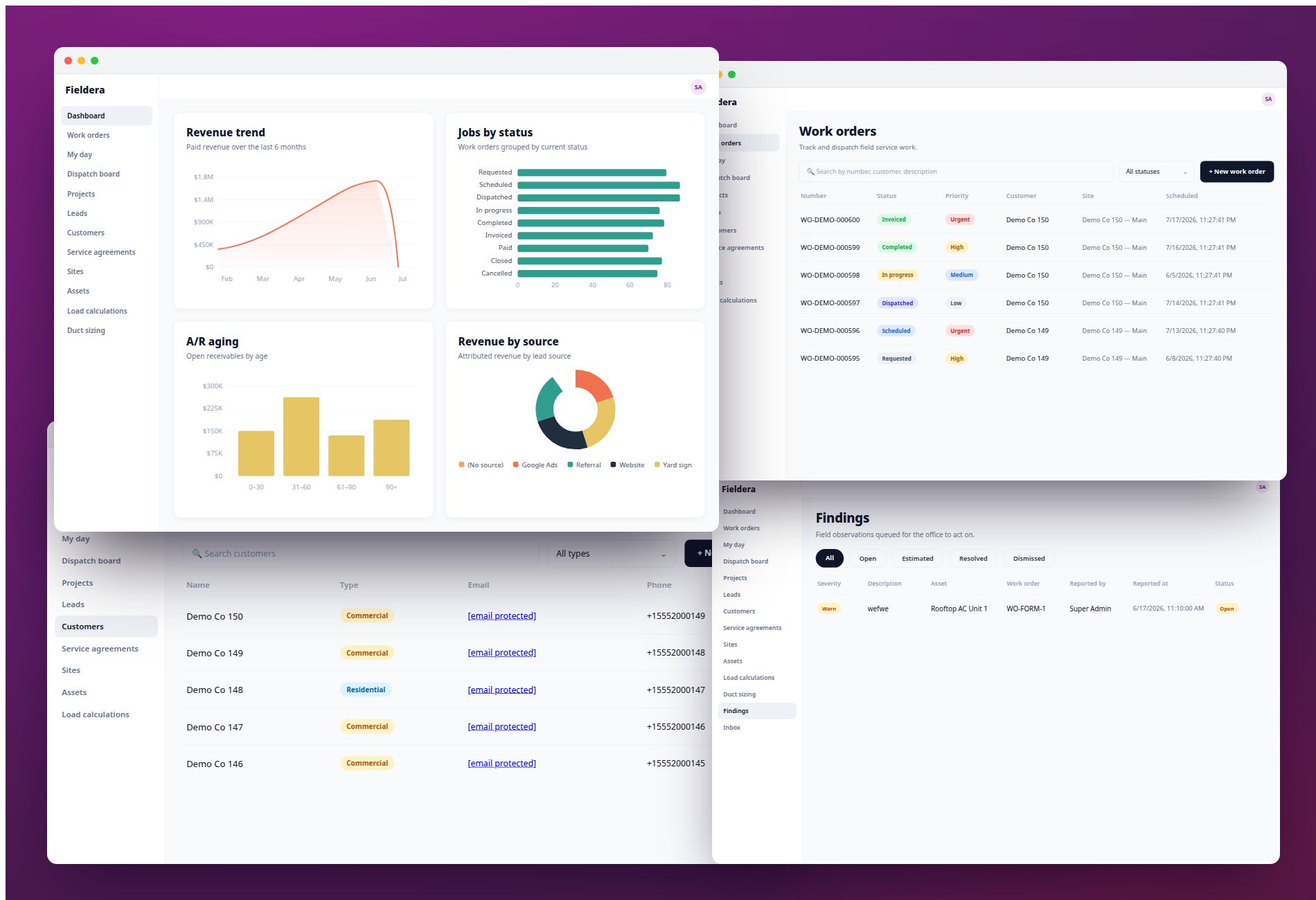
Fieldera applies the same principle at the vendor level. Instead of delivering a generic field service platform and asking an operations team to adapt their workflows around it, Fieldera configures the platform around the client’s actual dispatch rules, contractor processes, and compliance requirements from the start. The goal is the same one Eliot was solving for on his own: close the gap between how an operation actually works and what the software assumes it looks like, without a months-long translation process in between.
Fieldera is currently working with its first design partners on this approach.
What is AI-native software development? AI-native software development is building software where the person who understands the problem uses AI tools directly to design and prototype the solution, rather than relying entirely on a development team to translate a description into a first draft.
Can a non-technical founder really build software with AI? Eliot Vancil, who runs Fuel Logic and describes himself as not a coder, designed a full customer portal redesign inside Claude over three days, then handed a working prototype to his development team to put into production.
Does AI-built software still need a development team? Yes. In Fuel Logic’s case, the development team still built and maintained the production system. What changed is that they started from a concrete, testable prototype instead of a verbal description.
What’s the difference between AI-native building and no-code tools? No-code tools typically use fixed templates and drag-and-drop components within set limits. AI-native building, as described here, uses an AI assistant to design and prototype a custom interface and workflow directly, based on a natural-language description of what the person actually wants.
Is building software still expensive in 2026? Custom development still requires real investment. What has changed is the cost of the early iteration cycle, since a founder or operations lead can now produce a working prototype directly instead of paying for multiple rounds of developer time spent closing the gap between a description and a first draft.
Should a midmarket company build custom field operations software or buy off the shelf? The answer depends on how well an off-the-shelf tool matches the company’s actual dispatch and contractor workflows, and how large the gap is between paying for features the team doesn’t use and paying for a system built around a company’s specific compliance and operational requirements. Fieldera works with operations teams evaluating exactly this tradeoff for field service specifically.
Fieldera is a field operations platform built by Brocoders, configurable to your exact dispatch rules, contractor processes, and compliance requirements — deployed in weeks, not months.
Talk to us about your operation →