Jill Frattini, Service Coordinator at Ohio Heating, ran the numbers one afternoon and found something uncomfortable. Her team was paying $340 a month for field service software. And they were using maybe 30% of it.
The other 70% — pool cleaning workflows, lawn care invoicing, modules built for other trades — sat there, paid for, untouched. "When humidity levels and combustion analysis matter more than generic service notes," she put it, "you're funding someone else's wishlist."
She's not alone. Most field service operators who actually scrutinize their software spend find the same thing. The subscription fee looks reasonable on the surface. The real cost is elsewhere.
Before you sign up for a new FSM platform — or before you renew the one you have — understanding how pricing models work will save you from a bill that gets harder to justify every time you hire.
The pricing model most FSM software uses — and why it made sense
Per-seat pricing is the default in field service management software. Most platforms charge a monthly fee for each registered user. Typical range: $60 to $350 per seat per month, depending on the platform and feature tier. More than half of FSM buyers budget between $50 and $100 per user per month.
The logic behind the model is straightforward. You pay for the users who log in. If you have 5 technicians, you pay for 5 seats. Simple to quote, simple to forecast.
But how platforms define a "user" varies more than most buyers realize. Some charge only for field techs. Others bill for every person who touches the system: dispatchers, admins, supervisors, project managers. A team with 20 technicians often has 28 to 35 billable seats once office staff is counted.
Per-seat became the dominant model because it's easy to sell. Two vendors quoting the same monthly rate per seat can produce very different annual bills once you factor in who counts as a seat, what's included in each tier, and what lands on a separate add-on invoice.
What per-seat pricing actually costs as you scale
Here's the math most pricing pages don't show you.
| Team size | Seats (techs + admin) | $75/seat/mo | $100/seat/mo | $150/seat/mo | Annual at $100/seat |
|---|---|---|---|---|---|
| 10 techs + 3 admin | 13 seats | $975/mo | $1,300/mo | $1,950/mo | $15,600 |
| 20 techs + 5 admin | 25 seats | $1,875/mo | $2,500/mo | $3,750/mo | $30,000 |
| 50 techs + 10 admin | 60 seats | $4,500/mo | $6,000/mo | $9,000/mo | $72,000 |
| 100 techs + 15 admin | 115 seats | $8,625/mo | $11,500/mo | $17,250/mo | $138,000 |
Base license costs only. Excludes implementation, training, integrations, and premium support.
That last row is $138,000 a year before the platform does a single thing for your business. Not after go-live. Not after training. Just the seats.
And those are year-one numbers. For mid-market field service operations, a realistic 3-year total cost of ownership runs 2 to 3 times the year-one license. Enterprise deployments run 4 to 6 times. Implementation alone typically adds 1 to 2 times the year-one cost on top.
The headline rate covers maybe a third of what you'll actually spend.
The part per-seat pricing doesn't account for: what you actually use
Ohio Heating's situation isn't unusual. Most field service teams use roughly 30% of the features they're paying for. The other 70% exists because the platform was built to serve every trade — HVAC, pest control, security installation, lawn care, commercial plumbing — and the modules for the other industries come along for the ride.
There's no discount for the 70% you don't touch.
Daniel Vasilevski, Director and Owner of Pro Electrical, frames this a different way. "The biggest hidden cost is not the monthly fee for an off-the-shelf tool. The real cost is the daily friction added to your workflow. Many generic tools look good, but they are not designed for the specific requirements of the electrical business."
His calculation: if a technician wastes 10 to 15 minutes per job fighting a clunky interface, and the team runs 25 jobs a day, that's 250 to 375 minutes of paid labor going nowhere. Every day. That's not on the invoice. It doesn't show up in the seat count. But it's real spend.
The friction cost and the utilization waste sit outside the pricing model entirely. Per-seat pricing doesn't cause them. But it also does nothing to account for them when you're evaluating whether the spend makes sense.
The Seat Tax — naming the pattern
There's a specific behavior per-seat pricing produces in growing field service businesses.
Call it the Seat Tax.
The Seat Tax works like this: every time you hire a technician, add a dispatcher, or bring in a seasonal contractor, you face an immediate software cost increase. The new hire costs you salary plus a new seat, regardless of whether the platform actually supports their role better than a spreadsheet would.
Over time, operations managers start making decisions around the billing trigger. They delay adding a dispatcher to the system. They have subcontractors share a login. They build manual workarounds — spreadsheets, group texts, whiteboard schedules — because connecting those people to the FSM would mean paying for more seats.
The workarounds fill the gaps. The gaps are where operations break.
Rodion Salnik, who has worked on FSM implementations across the US and Europe, describes the mechanic directly: "They are paying per seat usually. And that means it doesn't matter how exactly they use the software — they're going to pay for all the seats."
The vendor's revenue grows with your headcount. Your value per dollar stays flat or declines.
Charlie, a field service expert with IFS experience, has watched the industry start to reckon with this: "IFS is trying to do it a little bit different so it's not like that where you're paying whether you're using it or not — it's paid based on your usage."
The market data confirms the direction. Pure per-seat pricing declined from 21% to 15% of SaaS vendors between 2025 and 2026. Hybrid pricing — base subscription plus usage overage — rose from 27% to 41% in the same period. The model is being replaced, not defended.
How usage-based FSM pricing works differently
In a usage-based model, you pay based on activity: work orders processed, jobs completed, or active users within a billing period. Not registered users. Not every person you've ever given a login.
A few things change structurally.
Seasonal businesses get pricing that matches their workload. Bring on 20 seasonal installers in Q4; your software cost rises during the busy months and drops when they leave. With per-seat pricing, you're paying for those 20 seats whether or not they're on a job.
Contractor-heavy operations stop paying growth penalties. Each new subcontractor doesn't trigger a permanent seat cost.
The alignment shifts too. In a per-seat model, the vendor earns more every time you hire — regardless of whether the software creates additional value for the new hire. In a usage-based model, the vendor earns more when you run more jobs. Your cost goes up because your revenue went up, not because your headcount did.
The tradeoff: usage-based pricing can feel less predictable, especially early on. If your job volume swings significantly month to month, so does the bill. For a very small, stable team — 3 to 5 techs running consistent volumes — per-seat can offer cleaner budget forecasting.
At 20 or more techs and growing, the math shifts sharply.
How to calculate your real FSM software cost before you sign
Five steps. Spend 30 minutes on this before any vendor demo, and you'll go in with better questions.
Step 1: Count all your seats, not just field techs. Include dispatchers, admins, supervisors, project managers, and any contractors who need system access. Most per-seat platforms bill for all of them. Get clarity on this before you get a quote.
Step 2: Run the 3-year number. Take year-one licensing and multiply by 2 to 3 for mid-market. Add implementation (typically 1 to 2 times year-one cost) and integration fees. That's the real commitment.
Step 3: Estimate your feature utilization rate. Of the modules included in your tier, how many does your team actually use? If the answer is under half, factor the dead cost in.
Step 4: Calculate your friction cost. Average jobs per day x average minutes of avoidable friction per job x hourly labor cost. A 20-tech team running 3 jobs each per day at 10 minutes of friction per job is 600 minutes — 10 hours — of paid labor monthly that produces nothing.
Step 5: Project your growth. If you're at 25 techs today and expect to be at 50 in 2 years, model what the seat count looks like then. At $100/seat with 70 total seats, you're at $84,000/year in base licensing. Ask whether that still looks reasonable next to the value delivered.
Which model fits which business
Per-seat pricing makes more sense when your team is stable and small (under 15 techs), user counts don't fluctuate with seasons or contracts, and budget predictability matters more than growth flexibility.
Usage-based pricing makes more sense when your team grows steadily or seasonally, you rely on subcontractors or part-time workers, and you'd rather have costs tied to output than to headcount.
Hybrid pricing — a base subscription plus usage overage — is now the most common model among newer FSM vendors. It gives some cost floor for forecasting while removing the per-head penalty on growth.
Before signing any FSM contract, ask these 3 questions:
- How do you define a billable "user"? Field techs only, or everyone with a login?
- Does the price change if I add a temporary contractor for 6 weeks?
- What's the 3-year total cost including implementation, integrations, and support?
A vendor who can't answer question 3 specifically is a vendor whose year-two invoice will be a surprise.
A note on what "fit" costs
The pricing model is only part of the equation. A competitively-priced per-seat platform still has a daily friction cost if it wasn't built for how your operation actually works.
Jill Frattini's team at Ohio Heating eventually built a custom dispatch board — $6,000 in development — specifically to handle certification-based routing and real-time equipment tracking that the generic FSM couldn't manage. That board paid for itself in 3 weeks by eliminating $400-plus wrong-tech-wrong-parts calls the off-the-shelf platform kept causing.
They were paying per seat for a platform that couldn't do the one thing they needed it to do.
The pricing model that makes sense for a growing midmarket field service operation is one where cost tracks output, not headcount. The platform that makes sense is one built around your dispatch rules and workflow requirements — not around the median of every trade using the same software.
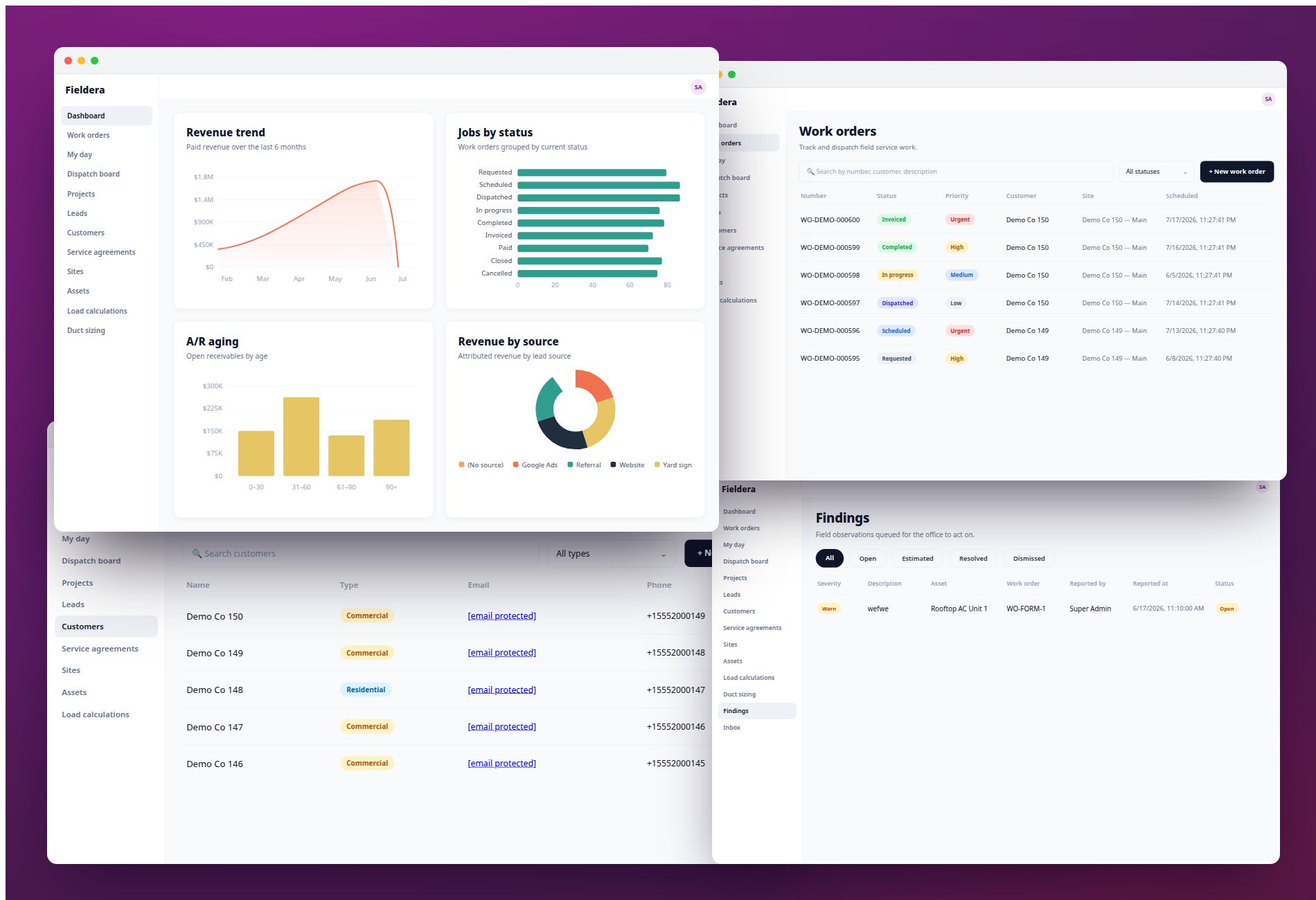
Fieldera is built by FSM practitioners at Brocoders, AI-configured to your specific workflows, and deployed in 4 to 5 weeks. There's no per-seat charge; pricing is usage-based. If you're evaluating alternatives to your current platform, talk to the team at fieldera.ai.
Frequently asked questions
How much does field service management software cost per month?
Typical range is $60 to $350 per user per month for mid-market platforms. Total monthly cost depends on team size, how the vendor counts "users," and which feature tier you're on. A 25-seat team at $100/seat pays $2,500/month in base licensing — before implementation, integrations, or support.
What is per-seat pricing in FSM software?
Per-seat pricing charges a recurring fee for each registered user in the system. Most FSM platforms use this model. The key variable is how the vendor defines a "user" — some charge only for field technicians, others bill every person with a login, including dispatchers and admins.
Is per-seat or usage-based pricing better for a growing field service business?
For teams under 15 techs with stable headcount, per-seat can offer cleaner cost predictability. For teams growing past 20 techs, adding seasonal workers, or relying on subcontractors, usage-based pricing typically delivers better economics by year 2 to 3.
What are the hidden costs of FSM software beyond the subscription?
Implementation (typically 1 to 2 times the year-one license for mid-market), training, integrations with ERP or CRM systems, premium support tiers, and user overage charges. A 3-year total cost of ownership for a mid-market deployment typically runs 2 to 3 times the year-one license.
How is usage-based FSM pricing calculated?
It varies by vendor. Some charge per work order completed, some per active user in a billing month, some per transaction volume. The key difference from per-seat: you pay for what the system actually processes, not for the count of people registered in it.
What does FSM software cost for 50 technicians?
At $100/seat with 10 admin staff added, 60 seats = $6,000/month in base licensing, $72,000/year. Factoring in a 2 to 3 times 3-year TCO multiplier, the realistic 3-year cost runs $144,000 to $216,000 before any custom configuration.
When does per-seat pricing stop making financial sense?
Generally once you pass 20 techs and expect to keep hiring, or once seasonal fluctuations mean you're paying for seats that are idle 3 to 4 months a year. At that point, usage-based or hybrid models deliver better long-term economics.
Fieldera is a field operations platform built by Brocoders, configurable to your exact dispatch rules, contractor processes, and compliance requirements — deployed in weeks, not months.
Talk to us about your operation →