Every year, the same articles appear. A rotating roster of tools competes for the top spot: Jobber for smaller crews, LMN for estimating and production tracking, Aspire for larger commercial operations, ServiceTitan for companies that want everything in one place. The comparison tables are thorough. The feature breakdowns are detailed. The pricing tiers are laid out clearly.
The buying cycle follows a predictable path. An operations manager runs out of patience with the current system, spends several weeks reading comparison posts, shortlists three options, requests demos, and signs with whichever tool most closely resembles what the team already uses. Twelve months later, the new software has been adopted for basic tasks, while everything complex still lives in spreadsheets, texts, and institutional knowledge.
The tools are not the problem. The frame is.
Landscaping businesses searching for better landscaping business software are almost always comparing options inside a category that was designed for a different era of operations. That category defines what "better" means, and that definition stops updating once a business grows past a certain level of complexity.
This article is not a ranked list. It explains the structural inflection point where landscaping-specific software stops working, the 2026 industry demands that are widening that gap, and the decision framework that comparison sites do not publish.
The category was built for simplicity, and that's the problem
Landscaping software emerged to serve owner-operators managing small maintenance crews on predictable weekly routes. The core use case was straightforward: schedule the mowing, send the invoice, track who got paid. Yardbook, Jobber, and early LMN were built for that context. They solved the right problems for their time and their audience.
The category has matured considerably since then. Route optimization, job costing, crew tracking, production logging, and chemical application records have all been added to various platforms. Pricing across the category now ranges from around $1,000 per year to more than $40,000 per year, with per-seat licensing that scales with headcount.
What has not changed is the underlying design assumption: the scheduling model is built around predictable, recurring service contracts on fixed weekly cycles. Every feature added to established landscaping platforms sits on top of that foundation.
That foundation creates three structural constraints that surface consistently as landscaping operations grow.
Configurability is limited by design. Jobber's most commonly cited limitation across user reviews is its fixed workflow structure. Companies with non-standard dispatch rules, equipment requirements, or technician certification matching needs eventually hit limits that no amount of configuration resolves. The platform was built to fit most users reasonably well. It was not built to fit any specific operation exactly.
Feature accumulation adds complexity without proportional benefit. Industry research from the Blue Collar Success Group found that most field service companies use only 30-40% of their FSM tool's features, with 80% of field operations running on just 20% of available capabilities. Extended implementation timelines of 6-12 months exist not because a client's operation is complicated, but because the software is.
Per-seat pricing penalizes growth. ServiceTitan and Jobber charge per technician. Growing a contractor workforce from 20 to 50 people more than doubles the software bill before a single additional job is added. The subscription becomes a tax on scaling.
What 2026 actually demands from landscaping business software
The structural constraints of the category would be manageable if the industry's operational demands had stayed stable. They have not.
The landscaping industry in 2026 is under simultaneous pressure from rising labor costs, persistent crew shortages, and margin compression that makes operational visibility a necessity rather than a feature. In 2024, 76% of landscaping contractors reported at least one unfilled position. Labor costs represent 25-40% of revenue across the industry. Getting more output from the same crews is not a strategic priority for 2026; it is the basic requirement for staying profitable.
Alongside those pressures, 41% of contractors now report that optimizing existing processes is their primary focus, ahead of expanding services or growing geographically (Aspire 2026 Industry Trends Report). That is a different buyer than the one landscaping software was originally built for. A company focused on operational excellence is not searching for more features. It is searching for a system that makes existing operations produce less daily friction and more visibility.
What "good enough" landscaping business software means in 2026 has shifted accordingly. Predictive scheduling built on actual crew performance data, not static time estimates. Real-time job costing that surfaces margin drift while the job is in progress, not at a year-end review. Retention-oriented CRM with automated renewal workflows and flags for at-risk accounts. Full tech-stack consolidation so that scheduling, invoicing, CRM, and compliance tracking are no longer separate systems held together by a person.
Established landscaping platforms are working to add these capabilities through product roadmaps. The challenge is architectural. A scheduling system built around static weekly routes does not become a predictive scheduling engine by adding a new module. The data model was set when the product was built. New capabilities layer onto that model rather than rewrite it, which means the integration feels bolted on because it is.
The consequence is predictable. Operations with complex, non-standard workflows ask platforms designed for simplicity to deliver sophistication, and find that the retrofit shows.
The Operational Complexity Threshold
The Operational Complexity Threshold is the point at which a landscaping business's operational model generates more friction from its current software than value from it. Below the threshold, any established tool handles the job. Above it, the question changes from "which landscaping software" to "does this system fit how the operation actually works."
Six signals indicate that a company has crossed it.
Dispatch blind spots. Dispatch knows a crew is en route to a job. What dispatch does not know is whether the site contact is available, whether the access code worked, or whether the job will run 40 minutes long because of an unexpected discovery on arrival. The office finds out when the next customer calls to ask where the crew is. At that point, scheduling has become damage control. As Emily Demirdonder of Proximity Plumbing put it: "By the time someone at the office finds out, you're not doing schedule management anymore. You're doing damage control."
Compliance workarounds. Chemical application logs, contractor certification tracking, multi-state licensing requirements, and permit workflows sit in spreadsheets alongside the scheduling tool. The software does not hold this data. Someone on the operations team maintains it manually and keeps it synchronized with the schedule by hand.
The wrong-tech-wrong-parts problem. Jobs are dispatched without automatically cross-referencing technician certifications, equipment specifications, or truck inventory. When the wrong crew arrives with the wrong materials, the emergency reassignment burns 20-40 minutes and the affected jobs cascade for the rest of the day. This happens often enough to become a recurring cost in dispatching time.
Per-seat pricing creep. Every contractor added to the field adds a predictable line to the software invoice. The business is paying a per-seat tax on its own growth. That math becomes visible somewhere around 30-40 contractors, and it gets harder to ignore with each hiring cycle.
The patchwork of systems. Scheduling sits in one tool, CRM in another, invoicing in a third, compliance records in a spreadsheet, and crew communication in a group chat. Someone on the operations team is the human bridge connecting data between systems. Matt Davis of SafeRacks described the situation directly: "Everything's kinda taped together, and so we just need it all in one place."
Year-round service expansion. When a landscaping company adds snow removal, seasonal lighting, or irrigation services to stabilize off-season cash flow, the scheduling requirements multiply. A second service line means different crew qualifications, different equipment logic, different compliance requirements, and different job types. Most landscaping scheduling software was built for one service line on a weekly maintenance cycle. Adding a second service line often means adding a second scheduling tool, which is the patchwork problem restated in a different form.
What a workflow-fit platform actually looks like
The question that separates a workflow-fit platform from a feature-rich one is this: does the system configure to the operation's specific workflows, or does the operation adapt itself to the system's available options?
For a landscaping company below the Operational Complexity Threshold, the second option works. For a company above it, the second option is where the daily friction originates.
A platform built around exact workflow fit handles several things differently from the start.
Dispatch logic is configurable. Emergency jobs, geographic constraints, technician certification requirements, and equipment specifications are held inside the system and enforced automatically at job assignment. Dispatch does not maintain a mental map of which crew can handle which job type. The system carries that logic and applies it.
Job-stage visibility is milestone-based, not GPS-based. Dispatch sees that a crew arrived on site, that the job started, that an issue was flagged, and that the job was completed with documentation submitted, without a phone call in either direction. When SafeRacks replaced a patchwork WordPress-based system with a workflow-fit platform, scheduling time per job dropped from 20 minutes to 4 minutes. The time was not saved by moving faster. It was saved because the system carried information that dispatchers had previously carried in their heads and communicated by phone.
As Daniel Vasilevski of Pro Electrical noted: "The biggest hidden cost is not the monthly fee for an off-the-shelf tool. The real cost is the daily friction added to your workflow." For a team of 30 field workers losing 10-15 minutes per job to a clunky app, that is several hours of paid labor absorbed by software friction every single day.
Compliance is embedded in the job workflow. Certification expiry dates, chemical application records, and permit status are checked at the point of job assignment. A technician without a current certification does not get assigned to a job requiring it. The compliance record is created as a byproduct of completing the job, not as a separate administrative task added after the fact.
Pricing is usage-based. Adding contractors to the field does not add a per-seat line to the subscription. Growth does not carry a software tax.
Deployment is measured in weeks. A modular FSM platform configured to specific workflows can be operational in 4-5 weeks. Extended implementation timelines reflect the complexity of the software product, not the complexity of the client's operation.
Five questions for any landscaping business software demo
These questions apply to any platform under evaluation, including Jobber, Aspire, LMN, Granum, and Fieldera. The answers reveal whether the platform fits the operation or whether the operation will be asked to fit the platform.
1. Can the scheduling logic enforce technician certification matching and equipment requirements automatically, or does dispatch do that manually?
A yes answer means the system holds operational logic. A no answer means that knowledge lives in a person.
2. What does "real-time visibility" mean in this platform: GPS location only, or can dispatch see job stage without the technician calling in?
GPS pinging is location awareness. Milestone-based status updates are field visibility. The difference matters when scheduling depends on knowing where a job actually stands.
3. Can the system track compliance data inside the job workflow, or does compliance tracking live outside the FSM tool?
Compliance records created as a byproduct of completing the job are accurate. Compliance records maintained separately are as current as the last manual update.
4. Is pricing per-seat or usage-based, and at what point does adding contractors increase the monthly cost?
The answer determines the long-term economics of the software relationship as the contractor workforce grows.
5. What does the deployment process look like, in weeks?
A deployment timeline longer than 8 weeks for a standard FSM implementation is a signal about the complexity of the product, not the complexity of the operation.
Where Fieldera fits
Fieldera is a field operations platform built by the FSM-specialist team at Brocoders, a software company with 10+ years building operational and workflow systems across installation, logistics, and contractor-based field operations.
The core difference from established landscaping platforms is architectural. Fieldera uses AI to configure the platform to a client's exact dispatch rules, contractor processes, and compliance requirements, rather than offering a fixed module set and asking the client to adapt.
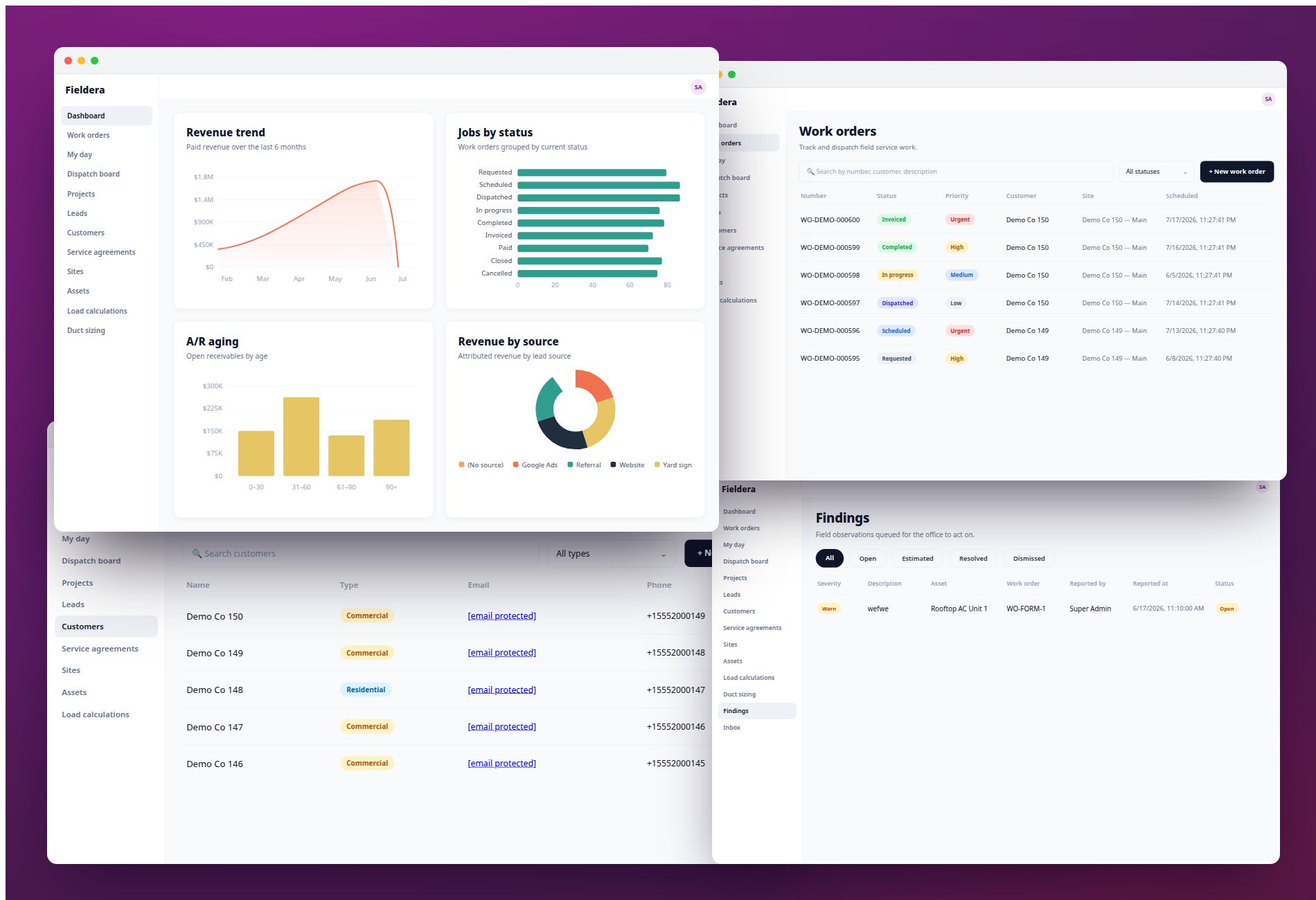
Standard FSM modules ship with every deployment: work orders and job management, scheduling and dispatch, technician mobile app, contractor management, job reporting and documentation, and invoicing. Company-specific logic, including custom dispatch rules, technician certification verification, multi-service scheduling, and site-specific compliance workflows, is configured to the exact operation. When a landscaping company adds a second service line, the scheduling logic for that service is added to the same system rather than managed in a separate tool.
Brocoders' experience includes SafeRacks and Eagle Industrial Group (garage rack installation across 50+ contractors and 8 states), CFI Furniture and TradeFlex (furniture installation with a two-sided contractor marketplace), Backbone International (event production field operations), and Revenue Boosters (vending route management). These builds are the source of the FSM patterns that Fieldera is configured from.
Deployment runs 4-5 weeks. Pricing is usage-based. The platform is hosted and maintained by Brocoders and adjusts as the operation's requirements change, without waiting in a vendor feature queue.
For landscaping operations that have crossed the Operational Complexity Threshold, or are approaching it, fieldera.ai shows how a configured FSM platform handles the problems that category-standard tools accumulate rather than solve.
Conclusion
The answer to "which landscaping business software should we use" depends entirely on where the operation sits relative to its Operational Complexity Threshold.
Below it, the established tools do the job well. Jobber for smaller crews with straightforward scheduling. LMN and Granum for operations focused on estimating and production tracking. Aspire for larger commercial companies that need enterprise-level reporting and job costing. These are well-built tools serving the audience they were designed for.
Above the threshold, the question changes. The right software is not the one with the most landscaping-specific features. It is the one that fits how the dispatch and field operations actually work, carries the compliance and qualification logic the team currently carries in their heads, and scales without penalizing growth. In 2026, with the operational demands on landscaping businesses rising faster than established platforms can retrofit, the distinction between those two answers matters more than it did five years ago.
FAQ
What is the best landscaping business software?
The best landscaping business software depends on the operational complexity of the company. For operations with straightforward scheduling needs, Jobber, LMN, and Granum are well-regarded options. For companies with complex dispatch logic, multi-service scheduling, compliance requirements, or contractor workforces above 30-40 people, the relevant question shifts from "which landscaping tool" to "which FSM platform configures to this specific operation."
What software do most landscaping companies use?
The most widely used platforms in the landscaping industry include Jobber, LMN (now part of Granum), Aspire, ServiceTitan, RealGreen, and Housecall Pro. Smaller operations often use Yardbook, which has a free tier. Larger commercial landscaping companies tend to use Aspire or ServiceTitan.
How much does landscaping business software cost?
Landscaping business software ranges from free (Yardbook) to more than $40,000 per year for enterprise platforms. Most mid-market solutions cost between $1,000 and $15,000 per year. Per-seat licensing adds cost as contractor headcount grows. Usage-based pricing models do not increase cost per technician added.
When should a landscaping company switch from Jobber to Aspire?
The decision is better framed around the Operational Complexity Threshold than around revenue figures. Indicators include scheduling that requires manual workarounds to manage, compliance tracking that lives outside the FSM tool, per-seat cost growing faster than revenue, and field visibility gaps that require phone calls to resolve. Aspire targets companies earning more than $1 million annually and dealing with siloed systems. For companies that need more configurability than either platform provides, a purpose-built FSM platform may be more appropriate than a lateral move within the same category.
Can landscaping software handle multiple crews and multiple locations?
Most established landscaping platforms support multiple crews and locations at the feature level. The practical constraint is how well the scheduling logic handles different service types, crew qualifications, and compliance requirements across those locations. Platforms built around a single service line and weekly maintenance cycles often require workarounds when applied to multi-location, multi-service operations.
What is the difference between landscaping software and field service management software?
Landscaping software is a category built specifically for landscaping businesses, with features like chemical application tracking, production logging, and seasonal route management. Field service management (FSM) software is a broader category built for any industry deploying field crews, including HVAC, plumbing, electrical, and installation services. Landscaping-specific tools are optimized for the common case. FSM platforms are typically more configurable, which matters when a landscaping operation develops non-standard dispatch requirements, compliance workflows, or contractor management needs that the standard landscaping category does not accommodate.
How long does landscaping business software implementation take?
Implementation timelines vary significantly. Entry-level tools like Jobber can be set up in days. Mid-market platforms typically require several weeks for full onboarding. Enterprise platforms like Aspire often require 6 months or more. A modular FSM platform configured to specific workflows can deploy in 4-5 weeks. Extended timelines generally reflect the complexity of the software product rather than the complexity of the client's operation.
Fieldera is a field operations platform built by Brocoders, configurable to your exact dispatch rules, contractor processes, and compliance requirements — deployed in weeks, not months.
Talk to us about your operation →