A dispatcher gets a call at 6:47 AM. Fuel delivery truck is on site. Gate code doesn't work. The site contact isn't answering. A piece of equipment is blocking the fill point that appeared overnight. The dispatch screen shows the truck as "on site." Green dot. No alerts. The driver is standing outside making judgment calls, and the dispatcher has no idea anything is wrong.
That gap — the last 20 minutes of a job, between arrival and completion — is where most field service breakdowns actually happen. Not from bad routing. Not from missed scheduling windows. From the absence of structured two-way communication once a technician reaches the job.
Eliot Vancil, CEO of Fuel Logic LLC, a nationwide fuel delivery and logistics company, put it plainly:
"The last mile communication gap. That 20-minute window is where service breakdowns come from. Every re-dispatch, every missed window and every customer escalation that we've ever had can be traced back to something that happened in that stretch. Scheduling is a problem that is solved. This isn't." — Eliot Vancil, CEO, Fuel Logic LLC
Most field service platforms were not built to solve that problem. They were built to solve scheduling, invoicing, dispatching, and reporting. ServiceTitan does those things very well — for the businesses it was designed around. But for a segment of field service operators, the platform creates as much friction as it removes.
This article is for that segment. Companies that have already evaluated ServiceTitan, or are using it, and are running into the same walls.
What ServiceTitan was built for
ServiceTitan is not a bad product. For high-volume residential service businesses — HVAC, plumbing, electrical — running large technician teams across well-defined service territories, it delivers real operational value.
John Williams, CEO of Stan's Heating, Air, Plumbing & Electrical with 31 years in the industry, uses ServiceTitan as his primary operations platform:
"We lean heavily on analytics from ServiceTitan because it helps us track technician performance, dispatching efficiency, and booking conversion in real time. For market conditions, it helps us allocate resources, set realistic sales targets, and anticipate seasonal swings rather than reacting to them." — John Williams, CEO, Stan's Heating, Air, Plumbing & Electrical
That use case — analytics-driven operations for a mature, scaled residential business — is exactly the market ServiceTitan built for. If that describes your operation, this article probably isn't for you.
The friction appears when the business model doesn't fit that profile. Complex dispatch logic. Non-standard job types. Compliance workflows specific to one industry or one client. Multi-region operations where every territory runs differently. Per-seat pricing that climbs sharply as the team grows.
Those businesses get a platform built for someone else's needs, and they pay for it every day.
Where ServiceTitan creates friction
The feature bloat problem
ServiceTitan's feature set is broad by design. It serves dozens of service verticals, which means every subscriber funds a roadmap built around the full cross-section of that market.
The practical result: most field companies use a fraction of what they pay for.
Jill Frattini, Service Coordinator at Ohio Heating in Columbus, described the cost directly:
"We were paying $340/month for software where our team only used maybe 30% of the features. Most platforms are built for generic 'field service' and charge for pool cleaning workflows, lawn care invoicing, and pest control modules when you just need HVAC-specific capabilities like refrigerant tracking and EPA compliance documentation. When humidity levels and combustion analysis matter more than generic 'service notes,' you're funding someone else's wishlist." — Jill Frattini, Service Coordinator, Ohio Heating
Nadine, Global Director of Service Operations at FläktGroup, ran into the same problem with a comparable enterprise FSM before building an internal solution. Her team was paying €150 per user per month — and using 20 to 30% of the available features. External consultants charged 30-hour monthly retainers to make minor adjustments to a platform that still didn't fit.
The math compounds. At $350 per seat per month across 20 technicians, that's $84,000 a year. If the team uses 30% of the platform, the effective cost of the features they actually use is closer to $280,000 annually.
The per-seat pricing trap
ServiceTitan's pricing scales by technician. As the field team grows, so does the monthly cost — regardless of whether each additional technician uses the platform more or less than anyone else.
Charlie, former VP of Services at IFS and founder of Clear Solutions, a field service ERP consultancy in Houston, has watched this dynamic play out across mid-to-large service companies for two decades:
"People are saying it's not fair anymore to charge per seat. It doesn't reflect your real usage — it doesn't matter how exactly they use the software, but they're paying for all the seats." — Charlie, Founder, Clear Solutions (former VP of Services, IFS)
His observation comes from watching businesses evaluate software transitions. Per-seat pricing works when the platform delivers proportional value per user. When teams use a fraction of the features and the price still climbs with each hire, the model stops making sense.
Usage-based pricing — paying for what you actually consume — is becoming the benchmark by which field operators evaluate subscription software.
Rigid workflows and the adaptation problem
ServiceTitan's configuration is extensive, but it has limits. The platform was built around a set of assumptions about how field service businesses operate: job types, dispatch logic, customer flows, technician workflows. Companies that match those assumptions configure their ServiceTitan environment and get moving fast.
Companies that don't match those assumptions adapt their operations to fit the software.
That adaptation has a real cost. Frattini's team at Ohio Heating built a custom dispatch board for $6,000 specifically to handle what their FSM couldn't:
"We ended up keeping a hybrid approach: basic FSM for routine maintenance appointments, but a custom dispatch board our team built for $6K that pulls real-time tech certifications and inventory. That board paid for itself in three weeks by eliminating the wrong-tech-wrong-parts trips that used to cost us $400 or more in wasted labor per call." — Jill Frattini, Service Coordinator, Ohio Heating
A $6,000 workaround that paid for itself in three weeks is not a sign that the core platform is serving the operation. It's a sign that the core platform has a gap the operation had to build around.
The scheduling complexity problem
Generic FSM dispatch logic assigns jobs based on technician availability, location, and schedule. That covers most of the predictable work. It breaks down for the work that generates the most revenue and the most risk.
Frattini described the emergency scenario where generic dispatch logic fails:
"Off-the-shelf tools assume every job is predictable. When a rooftop unit dies at 2 AM in a data center, we need to see which techs are certified for that specific VRF system, what parts are staged in which van, and which client has priority contracts — all while dispatching." — Jill Frattini, Service Coordinator, Ohio Heating
For businesses where that emergency scenario is weekly rather than exceptional — fuel delivery, commercial HVAC, electrical contracting, equipment maintenance — a dispatch board that doesn't hold certification data, inventory levels, and SLA tiers creates compounding operational risk.
The daily friction cost
The most visible costs of a poor software fit are easy to track: wrong-tech dispatches, re-dispatch incidents, missed SLAs. The harder cost to quantify is daily friction — the time technicians and coordinators lose fighting software that doesn't match how they work.
Daniel Vasilevski, Director and Owner of Pro Electrical, calculated it this way:
"The biggest hidden cost is not the monthly fee for an off-the-shelf tool. The real cost is the daily friction added to your workflow. My electricians need to be quick on the job site, not fighting an application. If a technician wastes 10 or 15 minutes on every job just trying to input data correctly, the losses are huge. We might complete 25 jobs in a day. Those lost times quickly add up to several hours of wasted labor that is paid, simply because of bad software." — Daniel Vasilevski, Director/Owner, Pro Electrical
25 jobs a day. 12 minutes of friction per job. That's 5 hours of paid technician time, daily, lost to software that doesn't fit. Across a 20-person team, that number becomes tens of thousands of dollars per month in wasted payroll — invisible in the P&L, but real.
Vasilevski's conclusion:
"We came to the conclusion that putting together a system that is built around our exact processes was the only smart financial decision. It costs more initially but it removes that daily friction. This allowed my team to do more jobs and keep our service up without the daily frustration. The ROI came from that recovered time." — Daniel Vasilevski, Director/Owner, Pro Electrical
What a ServiceTitan alternative needs to solve
Most alternatives on the comparison lists (Jobber, Workiz, Housecall Pro, FieldPulse) solve specific parts of the problem — primarily pricing and simplicity. They don't solve workflow complexity, because they're built for the same category of customer ServiceTitan targets: high-volume, relatively standardized service businesses.
The alternatives worth evaluating for operationally complex field companies solve for different things:
Dispatch logic that matches how the operation actually runs. Certification matching, priority SLA flags, real-time inventory visibility, and custom routing rules — configured to the business's actual dispatch process, not a generic template.
No per-seat pricing. A usage-based model where growth doesn't automatically translate to a larger monthly invoice.
Fast deployment. Charlie's benchmark from IFS implementations — "12 to 18 months" for a mid-market company — is industry reality for enterprise FSM. The alternative for companies that need to operate, not implement, is a platform that can be configured and live in weeks.
Workflows that fit the operation. The software maps to how the business dispatches, documents, and manages fieldwork. The business doesn't rebuild its processes around the software.
Integration with existing business infrastructure. ERP, WMS, CRM, and accounting connections that don't require workarounds to function.
How Fieldera approaches the ServiceTitan alternative problem
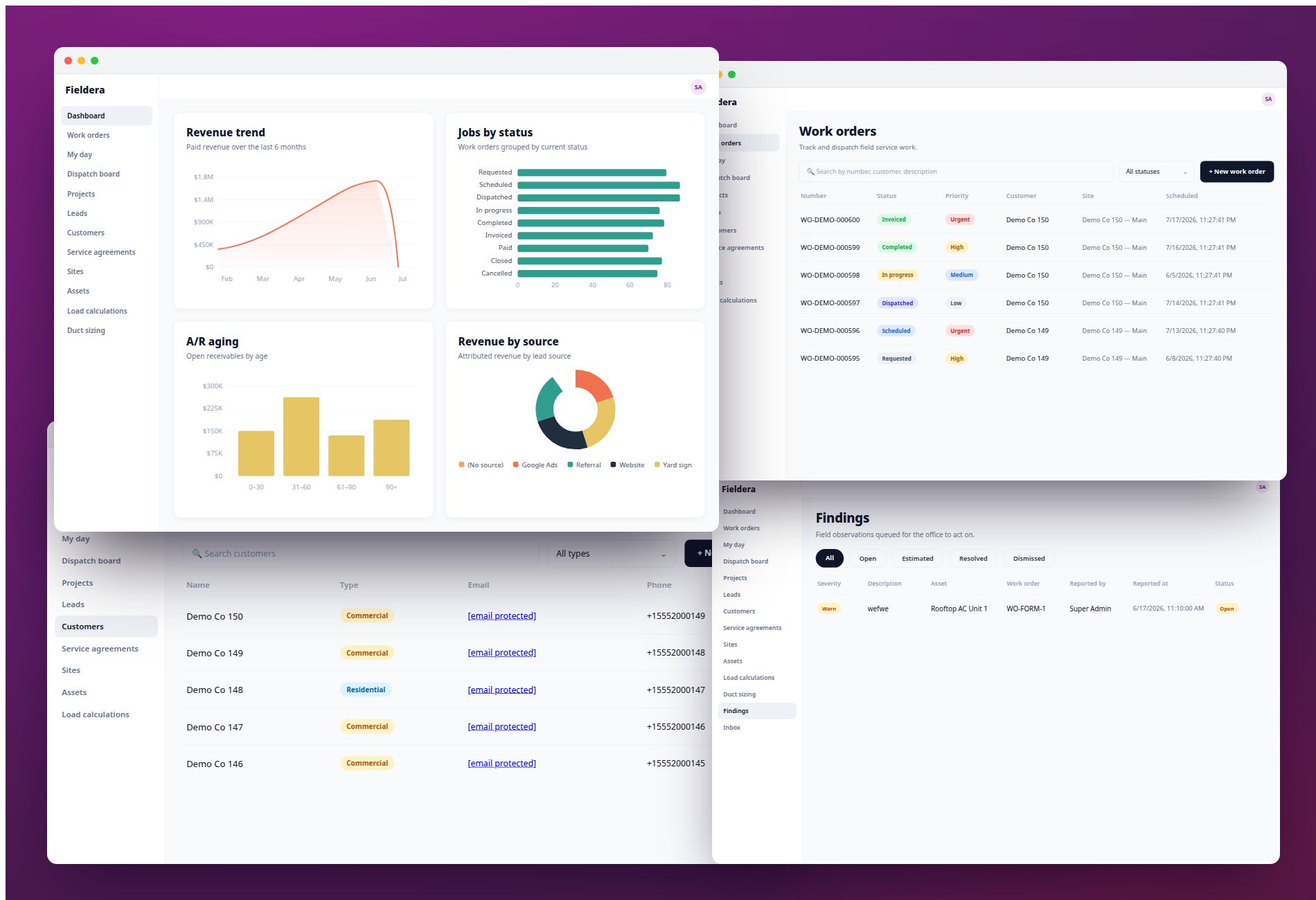
Fieldera is a field operations platform built by Brocoders, a software company with 10 years of experience building field service systems across installation, logistics, and contractor operations. The platform is AI-configured — which means it's shaped to the client's specific dispatch rules, compliance requirements, and operational workflows before it goes live, rather than after months of configuration.
The deployment timeline is 4 to 5 weeks:
- Week 1: Operational analysis — map current workflows, identify integration points, define requirements
- Week 2: System design — configure modules, design custom workflows, plan integrations
- Week 3: Configuration and integrations — build and connect all systems, test with real operational scenarios
- Week 4: Deployment — go live with team training, handover documentation, and ongoing support
Every Fieldera deployment includes standard FSM modules: work orders, scheduling and dispatch, technician mobile interface, job reporting, time and materials tracking, contractor management, CRM, inventory and asset tracking, and invoicing.
The AI-configured modules on top of that are where the operational fit comes from: site-specific compliance workflows, permit and safety management logic, worker qualification verification, custom dispatch and routing rules, and AI-generated preparation packs that give technicians the information they need before they arrive on site.
Pricing is usage-based. No per-seat fees. The client owns the system.
That last point matters for operations that expect to grow. Adding 10 technicians to a ServiceTitan account adds 10 lines to the monthly invoice. Adding 10 technicians to a Fieldera deployment adds usage, not seats.
Who Fieldera is the right ServiceTitan alternative for
Fieldera is not the right choice for every operation evaluating ServiceTitan alternatives. The fit is specific.
The businesses Fieldera is built for share a profile: midmarket field operations with a distributed workforce, complex scheduling requirements, and operational specifics that standard FSM platforms were not designed to hold. The qualification isn't industry — it's operational model.
The clearest signals that Fieldera is worth evaluating:
- Dispatch decisions depend on real-time technician certifications, van inventory, or client SLA tier — and the current platform doesn't hold that logic
- The team has built workarounds (spreadsheets, secondary apps, hybrid systems) to handle what the FSM can't
- Per-seat pricing is growing faster than operational value
- The business uses 30% or less of the current platform's features
- Compliance documentation (EPA, safety, industry-specific permits) lives outside the FSM and requires assembly after the fact
- A previous evaluation of custom development was ruled out due to cost or timeline
If three or more of those apply, the problem isn't finding a cheaper version of ServiceTitan. The problem is platform fit. And a cheaper, slightly simpler SaaS tool won't solve a platform fit problem.
Frequently asked questions
Is ServiceTitan too expensive for mid-market field service companies?
"Too expensive" depends on the value delivered, not just the dollar amount. ServiceTitan pricing ranges from roughly $150 to $500 or more per technician per month, depending on the plan and modules selected. For businesses that use the platform's full feature set for residential service operations, the ROI is typically there. For businesses using 30% of the features while paying full price — and building workarounds for the 70% the platform doesn't handle — the cost is harder to justify.
What is the main difference between Fieldera and ServiceTitan?
ServiceTitan is a SaaS platform with a fixed feature set built around residential service verticals. Fieldera is configured to the client's specific workflows, dispatch logic, and compliance requirements — the platform fits the operation, not the other way around. The deployment model also differs: Fieldera is live in 4 to 5 weeks, and pricing is usage-based rather than per seat.
Does Fieldera replace ServiceTitan for HVAC companies?
For HVAC companies with standardized residential service operations, ServiceTitan likely remains a strong fit. Fieldera is better suited for HVAC companies where dispatch complexity — certification matching, multi-region operations, commercial accounts with SLA tiers — generates friction in current tools.
What ServiceTitan alternatives are worth comparing?
For small and growing residential service businesses, Jobber, Housecall Pro, FieldPulse, and Workiz all offer simpler, lower-cost platforms. For businesses with operational complexity that generic FSM tools don't cover — custom dispatch logic, compliance workflows, fast deployment — Fieldera is designed for that specific segment.
How long does it take to switch from ServiceTitan to Fieldera?
Fieldera deployments take 4 to 5 weeks from operational analysis to go-live. That includes workflow mapping, system configuration, integration with existing ERP or CRM, and technician training. For comparison, enterprise FSM implementations (IFS, ServiceNow) typically run 12 to 18 months.
Does Fieldera support EU and US compliance requirements?
Yes. Fieldera supports data handling standards, security requirements, and industry-specific compliance workflows for both EU and US markets.
The decision
ServiceTitan works. For the businesses it was built for, it works very well. The question for every field service company evaluating alternatives is whether their operation matches the profile that software was designed around.
If the answer is yes — high-volume residential service, standardized job types, a large team running predictable routes — ServiceTitan is a reasonable choice and the alternatives in the same category (Jobber, Workiz, Housecall Pro) offer similar tradeoffs at lower price points.
If the answer is no — complex dispatch, compliance-heavy workflows, per-seat pricing that's climbing faster than the value it delivers, workarounds that have become part of the standard operating procedure — then the evaluation shouldn't stop at finding a cheaper version of the same thing.
The companies in that second category need a platform built around how they actually operate. That's a different search.
Fieldera is a field operations platform built by Brocoders, configurable to your exact dispatch rules, contractor processes, and compliance requirements — deployed in weeks, not months.
Talk to us about your operation →