AI-configured FSM software is a field service management platform configured by AI agents to match a company's exact workflows before it goes live. The AI maps your dispatch rules, routing logic, contractor processes, and compliance requirements, then builds the system around them. You get software that fits how you actually work, deployed in 4 to 5 weeks, at a fraction of what custom development costs.
Every FSM platform now offers AI. The problem isn't the features.
The vendor pitch sounds reasonable. AI scheduling puts the right technician on the right job. Smarter routing cuts drive time. Predictive maintenance alerts the team before a breakdown becomes a missed SLA. AI-generated job prep packs mean technicians arrive with the right parts and programming devices.
All of that is real. Those features work.
But the pitch carries an assumption: that the software already fits your workflows. That the dispatch logic already maps to how you route jobs, accounts for your tech certifications, and reflects your priority contracts. AI features get built assuming that fit already exists.
Eighty percent of field service operations run on just 20% of a platform's features, according to FieldAx research from March 2026. Companies pay full SaaS price for a tool shaped around a generic version of their business.
Jill Frattini, Service Coordinator at Ohio Heating in Columbus, pays $340 a month for FSM software her team uses at 30% of capacity. The features that matter to them, the tool handles poorly. So they built a $6,000 custom dispatch board alongside it, just to manage emergency commercial calls correctly.
The AI features didn't solve the underlying problem. The platform still doesn't fit.
The real bottleneck is workflow fit, not feature count
Every operations team that has outgrown a generic FSM describes the same pattern. The software works, technically. But the team works around it constantly.
Daniel Vasilevski, owner of Pro Electrical in Australia, ran the math: "If a technician wastes 10 or 15 minutes on every job just trying to input data correctly, the losses are huge. We complete 25 jobs in a day. Those lost times quickly add up to several hours of wasted labor, simply because of bad software."
That friction is a configuration gap. Software shaped around a generic workflow rather than this operation's actual logic.
Mika, CEO of Finnsiirto Oy, a forklift rental and service company in Finland, pays close to €85,000 a year for a DMS that, in his words, is "way, way, way worse than perfect." Twenty percent of his workflows still run outside the system, handled manually because the software doesn't reflect how his operation works.
Pekka, CEO of a heavy equipment company running 30 technicians and 180 drivers across 24/7 operations, describes it plainly: "There can be 2 or 3 overlapping programs. It eats up working time." Service visits "go to hell" when a technician arrives without the right part or programming device, because the dispatch logic didn't account for job-specific requirements.
The pattern across all of them: two systems in parallel, manual workarounds alongside the FSM, or a custom board built to fill the gap the main platform can't close.
The cost of that gap is measurable. Eliot Vancil, CEO of Fuel Logic, a national fuel distribution company in Dallas, tracked the improvement from cutting fuel-flow initiation time from 14 minutes to 9. Five minutes per stop across 50 trucks translates to a 10% increase in network throughput. Tight workflow fit generates real operating capacity. Loose fit burns it.
What AI-configured FSM software actually means
AI-configured FSM software is the category between rigid SaaS and custom development.
Traditional SaaS FSM platforms are built for a generic version of field service. You configure them to match your operation as closely as the template allows. When your workflows don't fit the template, you work around it, or pay for professional services to push the customization as far as the vendor permits.
Custom development gets the fit right. It builds the system around your exact workflows, dispatch logic, and compliance requirements. But it costs $80,000 to $150,000 upfront, takes 6 to 12 months to deliver, and locks you into a system that needs expensive dev work every time the operation changes.
AI-configured FSM solves the configuration problem directly. Before go-live, AI agents analyze how the operation actually works: dispatch logic, routing rules, contractor processes, job-type requirements, compliance workflows. The platform gets built around those specifics before anyone logs in for the first time.
What gets configured includes standard modules (work orders, scheduling, dispatch, mobile interface, invoicing) and company-specific modules built around the operation's actual complexity: site compliance workflows, permit and safety management logic, worker qualification verification, custom routing rules, and AI-generated preparation packs for technicians.
The distinction from "AI-powered FSM" is concrete. AI-powered FSM adds intelligent features inside your live software. AI-configured FSM uses AI to do the configuration work before your software goes live.
One improves a running tool. The other fits the tool to the operation before anyone logs in.
| Traditional SaaS FSM | Custom development | AI-configured FSM | |
|---|---|---|---|
| Workflow fit | Generic (you adapt to it) | Exact fit | Exact fit |
| Time to go live | Days to weeks (setup only) | 6–12 months | 4–5 weeks |
| Cost | $60–$350/seat/month | $80K–$150K upfront | Fraction of custom dev |
| Pricing model | Per seat | Owned | Usage-based, you own it |
| Adapts when operation changes | Vendor roadmap | Custom dev again | Yes |
| AI role | Features inside the tool | None or add-on | Configuration layer |
How AI-configured FSM works: the 4-week process
The 4-week deployment timeline sounds fast. It's fast because most of the work happens before anyone touches the software.
Week 1: Operational analysis. AI maps the current operation: dispatch logic, scheduling rules, integration points with ERP, CRM, or WMS, and the job-type requirements that make the business specific. The work is real workflow analysis, grounded in how the operation actually runs.
Week 2: System design. Standard modules get configured. Custom workflows get designed. Integration architecture gets planned around the actual tech stack.
Week 3: Configuration and integrations. All systems get built and connected. Workflows get tested against real operational scenarios, not generic use cases.
Week 4: Deployment. The team goes live with training, handover documentation, ongoing support, and a full record of every configuration decision made.
That path contrasts with how most mid-market FSM implementations actually go. Professional services alone typically run $10,000 to $30,000, on top of the SaaS license. The go-live timeline sits at 4 to 12 weeks, and customization requests often trail for months after that.
The difference is that configuration is the product here. Most SaaS onboarding assumes you'll configure the tool yourself after paying for it. AI-configured FSM treats the configuration work as the deliverable.
Who AI-configured FSM is built for
Two types of operators find themselves looking at this category.
The first has been on a generic FSM for years. They use 30% of the features, pay full price for the rest, and run manual workarounds for the parts of the operation the software doesn't handle. Their dispatch team knows the workarounds by heart. New hires take months to learn them. Every workaround is a failure cost the P&L doesn't capture directly.
The second type runs the operation on spreadsheets and WhatsApp. They know they need FSM software. They've been burned by implementations that took six months to go live and still didn't fit. They want something that maps to how they already work.
Both share the same underlying requirement: a platform that reflects actual dispatch logic, actual job types, actual compliance requirements. Generic templates don't get there. Custom dev gets there but at a cost most mid-market operators can't absorb.
The buying trigger is rarely budget. It's usually a specific operational failure: a missed high-value SLA, a compliance incident, a dispatch manager who can't scale capacity with the current setup, or a CEO who runs the math on another year of feature bloat against the cost of something that actually fits.
AI-configured FSM isn't for everyone. If every job looks the same and the default scheduling templates work, a standard SaaS FSM does the job. The fit problem surfaces when operational complexity outgrows what templates can handle.
Pekka's description of wanting "a crystal ball" to see what his operation was doing three days ahead captures the signal. When the operation is complex enough that planning ahead requires visibility the current system can't provide, the configuration gap is real.
Why this approach is gaining ground in 2026
The FSM software market is growing at 16.2% CAGR through 2030, projected to reach $9.7 billion. More competitors using software-driven field operations means workflow fit becomes a differentiation factor, not just an ops preference.
The economics have also shifted. AI capability costs have dropped enough that AI-configured deployment at the mid-market price point is viable now. Three years ago, the compute cost of that configuration layer made it sensible only for enterprise contracts.
The patchwork tax is becoming visible on P&Ls. Finnsiirto quantifies it as 20% of workflows running manually outside the DMS. Pekka's company quantifies it as working time eaten by 2 to 3 overlapping systems. These costs were always there. Operations teams are starting to name them.
Generic SaaS vendors are adding AI features, but that doesn't close the configuration gap. A smarter scheduling algorithm on top of mis-fit workflow logic still dispatches the wrong tech to the wrong job with the wrong parts.
As fieldcode.com noted in an independent industry analysis: "Off-the-shelf tools don't fit, but custom builds carry long-term cost burdens, and both paths fail when workflow fit isn't the primary evaluation criteria."
The configuration layer is what both paths skip.
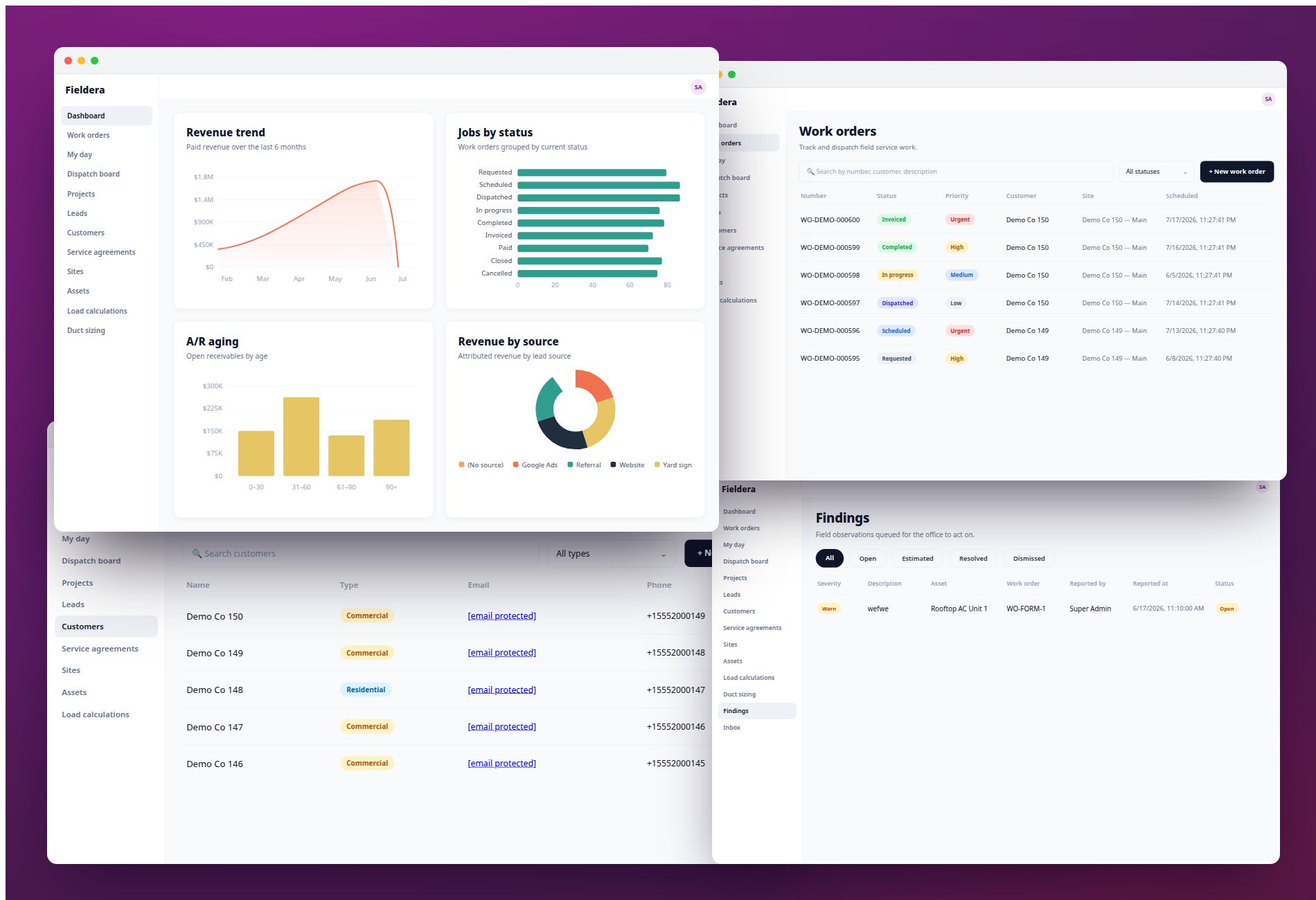
Fieldera: AI-configured FSM for midmarket field operations
Fieldera is an AI-configured FSM platform built by Brocoders, a software company with 10+ years building operational systems across global markets and 80+ products shipped.
Every Fieldera deployment includes standard modules (work orders, scheduling, dispatch, mobile workflows, invoicing) and company-specific modules configured by AI agents to the client's exact workflows. Dispatch rules, routing logic, compliance requirements, and contractor processes all get built into the system before go-live.
The deployment timeline is 4 to 5 weeks. Pricing is usage-based with no per-seat model. The client owns the system.
Fieldera is currently working with design partners: field service operations that want a platform shaped around their workflows, with direct input into product direction and preferential terms in exchange.
If your operation has outgrown generic FSM and custom development doesn't pencil out, the design partner program is worth a conversation.
Frequently asked questions
What is AI-configured FSM software? AI-configured FSM software uses AI agents to analyze a company's existing workflows and configure the field service management platform to match them before it goes live. Dispatch rules, routing logic, compliance requirements, and job-type specifics get built into the system rather than approximated from a generic template.
How is AI-configured FSM different from AI-powered FSM? AI-powered FSM adds intelligent features (predictive scheduling, smarter routing, maintenance alerts, automated dispatch recommendations) inside a live software platform. AI-configured FSM uses AI to do the configuration work before the platform goes live. One improves a running tool. The other fits the tool to the operation before anyone logs in.
How long does AI-configured FSM implementation take? A standard AI-configured FSM deployment runs 4 to 5 weeks: Week 1 for operational analysis, Week 2 for system design, Week 3 for configuration and integrations, Week 4 for deployment. That compares to 4 to 12 weeks for typical mid-market SaaS FSM implementations, which often carry partial configuration that extends for months.
What does AI actually configure in a field service platform? AI agents configure dispatch rules, routing logic, contractor processes, job-type requirements, and compliance workflows. Standard modules (work orders, scheduling, mobile interface, invoicing) get configured alongside company-specific modules: site compliance workflows, permit and safety management logic, worker qualification verification, custom routing rules, and technician preparation packs.
Is AI-configured FSM the same as custom FSM development? The workflow fit is comparable. Custom development builds the system around exact specifications and costs $80,000 to $150,000 upfront with a 6 to 12-month delivery window. AI-configured FSM reaches the same workflow fit at a fraction of the cost in 4 to 5 weeks. The client owns the system either way.
Who is AI-configured FSM designed for? Midmarket field service operators with operational complexity that generic SaaS templates can't handle. Typically, companies running 15 to 80 field technicians with complex scheduling requirements, compliance paperwork, or dispatch logic that produces manual workarounds when forced into a generic platform.
What does AI-configured FSM cost compared to traditional SaaS? Traditional SaaS FSM runs $60 to $350 per seat per month. Mid-market teams typically pay $5,250 to $12,000 a month in total, plus $10,000 to $30,000 in professional services at implementation. AI-configured FSM uses a usage-based model with no per-seat pricing. The client owns the system rather than paying an ongoing license for a platform they partially use.
Fieldera is a field operations platform built by Brocoders, configurable to your exact dispatch rules, contractor processes, and compliance requirements — deployed in weeks, not months.
Talk to us about your operation →