A US garage rack installation company was running its scheduling system on WordPress, a few custom APIs, and three separate services stitched together over the years. It worked, until a Google license lapsed. Nobody caught it. Customers stopped receiving booking confirmations, and by the time the team figured out which piece of the stack had failed, they'd missed a week of appointments.
That company came to Brocoders. Their words: "Everything's kinda taped together and we just need it all in one place."
They're not unusual. Most mid-market field service businesses hit the same wall eventually. And when they do, most of the advice they find frames the decision as two options: buy an off-the-shelf platform, or build custom software.
There are actually three paths. This comparison covers all of them, with real costs and timelines, so you can decide which one fits your operation.
The patchwork problem
The typical mid-market field service stack looks like this: a scheduling tool, a separate CRM, an invoicing system, a mobile app for field techs, and a spreadsheet someone maintains manually to hold it all together.
56% of HVACR contractors now have field service management software, according to the 2025 ACCA Contractor of the Future Study. Most of them underutilize it, treating it like "a glorified QuickBooks."
One HVAC company put the cost plainly: "We were paying $340/month for software where our team only used maybe 30% of the features."
The adoption gap isn't that operators don't want better software. It's that the software they bought was built for the average field service company, not for theirs.
When the patchwork starts costing more to maintain than it saves, the decision you face is which approach fits your operation. Not which product to try next.
Path 1: Buy off-the-shelf FSM
Off-the-shelf platforms are the fastest way to get running. ServiceTitan, Jobber, Microsoft Dynamics, Housecall Pro — mature products with large feature sets, active user communities, and predictable pricing.
The pricing is also where the picture gets complicated.
Basic plans start around $50 per user per month. Advanced plans reach $350 per user per month. For a mid-size company with 15-40 technicians, total monthly costs typically run between $5,250 and $12,000. Before implementation.
Budget an additional 1.5-3x your Year 1 subscription for implementation, data migration, integration work, and training. If you switch platforms later, factor in another 6-12 months of your new vendor's pricing to cover contract overlap, productivity loss, and retraining.
The deeper structural issue: off-the-shelf platforms are built for the modal customer. They optimize for the most common dispatch rules, the most common compliance requirements, the most common workflow patterns. If your operation matches those defaults closely, they work well.
Charlie, a former VP of Services at IFS who now runs Clear Solutions, a field service consultancy in Houston, describes what happens when there's a mismatch: "HVAC companies find IFS too complex. They're used to their spreadsheets, they like to change things on the fly. A larger ERP locks things down."
Harry Rao, who built Paperless, an FSM platform for Australian contractors, ran into the same issue from the product side. His workaround: "I turned off most features. Put in feature flags, toggled them all off, and introduced them one at a time."
That describes what happens when generic software meets non-generic operations.
Buy if:
- Your workflows match industry-standard FSM features with minor customization
- You have fewer than 15 technicians and per-seat pricing doesn't yet compound against you
- You need to go live immediately and can adapt your processes to the tool
Path 2: Build custom FSM
Custom software fits your operation exactly. You own it, you control its roadmap, and you're not paying for features your team doesn't use.
The cost is significant. Clutch's 2026 analysis of verified software development projects puts the average custom software build at $132,480, with a typical timeline of 13 months from kickoff to launch. Field service applications — requiring a web dashboard, a mobile app for technicians, offline-capable data sync, GPS tracking, and often hardware integrations — tend to land above that average.
The timeline is the more underrated risk. Charlie describes what drives it: "It's typically about a 12-18 month process. Because it's so configurable, we need to understand the business first." The bottleneck isn't writing code. It's requirements gathering: understanding how dispatch actually works, what the compliance chain looks like, how technicians document jobs in the field.
After launch, you own the maintenance responsibility. Every update, every bug fix, every integration with a new tool requires either an ongoing developer relationship or internal technical capacity. Most field service companies aren't software companies.
There's also the scenario Charlie describes repeatedly with mid-market operators: companies that built custom systems years ago and then outgrew them. "In reality, they probably would have been better off building something new that was specifically for them — but an ERP was still too much for them."
They needed something in between.
Build if:
- Your specific operational workflow is your competitive advantage, not just a preference — routing logic, compliance chains, or contractor management that no off-the-shelf tool can model
- You have $150k+ budget and 12-18 months of runway before you need the system live
- You have internal technical capacity to maintain and evolve the system after launch
Path 3: AI-configured FSM
The third path didn't have a name until recently.
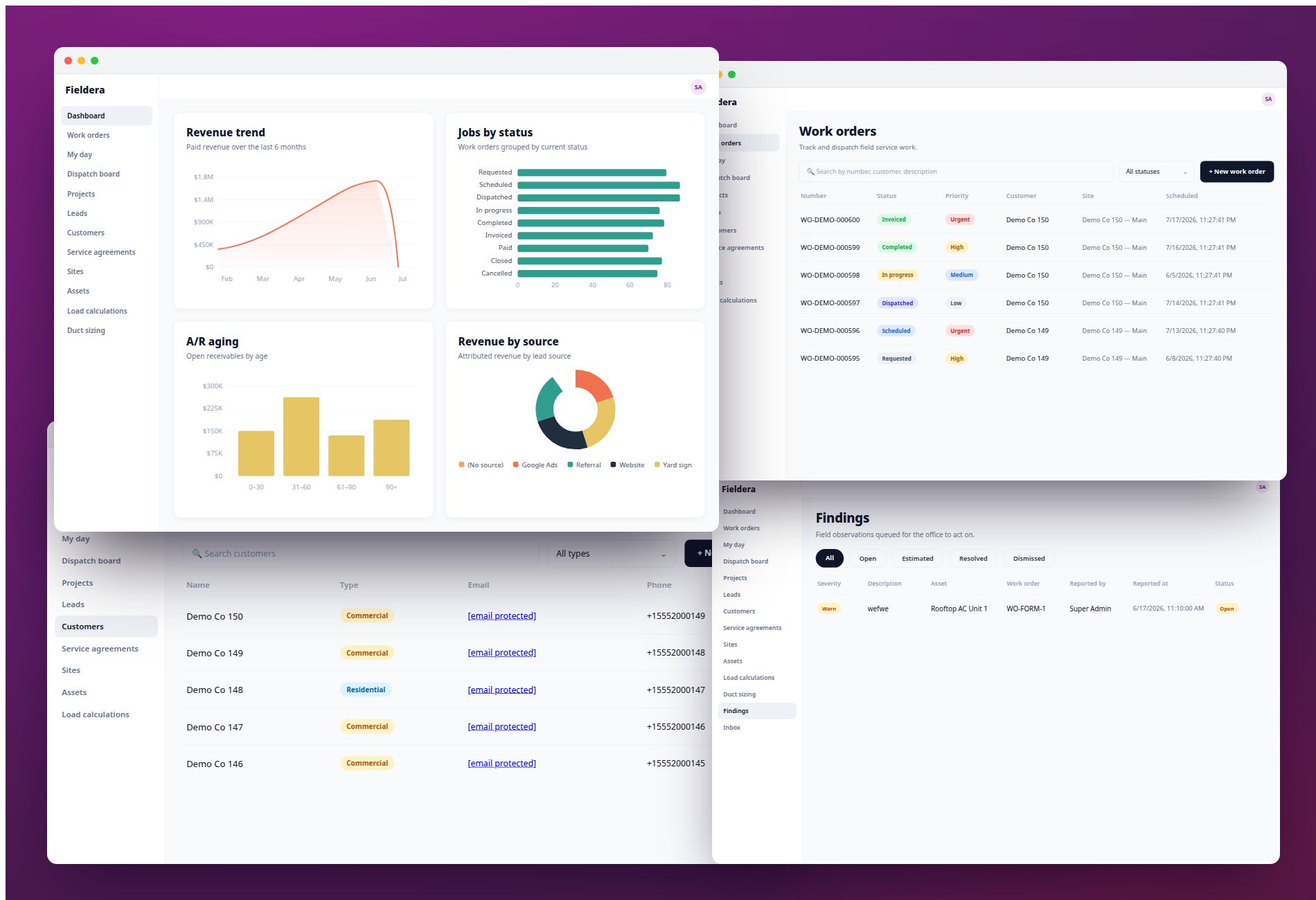
It sits between buying a generic platform and commissioning a 13-month custom build. It starts with a pre-built platform that already contains field service domain expertise — standard modules for work orders, scheduling, dispatch, technician mobile interface, invoicing, CRM, and inventory management. Then, instead of asking you to adapt your workflows to the platform, AI agents configure the platform around how your operation actually works.
You describe your dispatch rules, compliance requirements, contractor processes, and routing logic. The system builds the configuration around those inputs. What gets deployed is a working product shaped to your operation.
The timeline is 4-5 weeks from kickoff to live system.
The pricing is usage-based, with no per-seat fees. Your costs don't scale against you as you hire.
Eagle Industrial Group, a warehouse rack installer coordinating installation jobs across independent contractors, went through this process. The result: 3x faster scheduling and a system handling 200+ installation jobs with a level of coordination their previous stack couldn't support.
Revenue Boosters, a vending route management company, built a full operational system in 3.5 months. Reporting speed improved by 60%.
Harry Rao, who has spent years selling FSM software to Australian trade businesses, described the concept when Rodion walked him through Fieldera's approach: "This is actually a platform that helps you not build something you're not going to use."
Off-the-shelf gives you everything, configured for the average operator. Custom gives you exactly what you need, after 12-18 months. AI-configured gives you what fits your operation, in weeks.
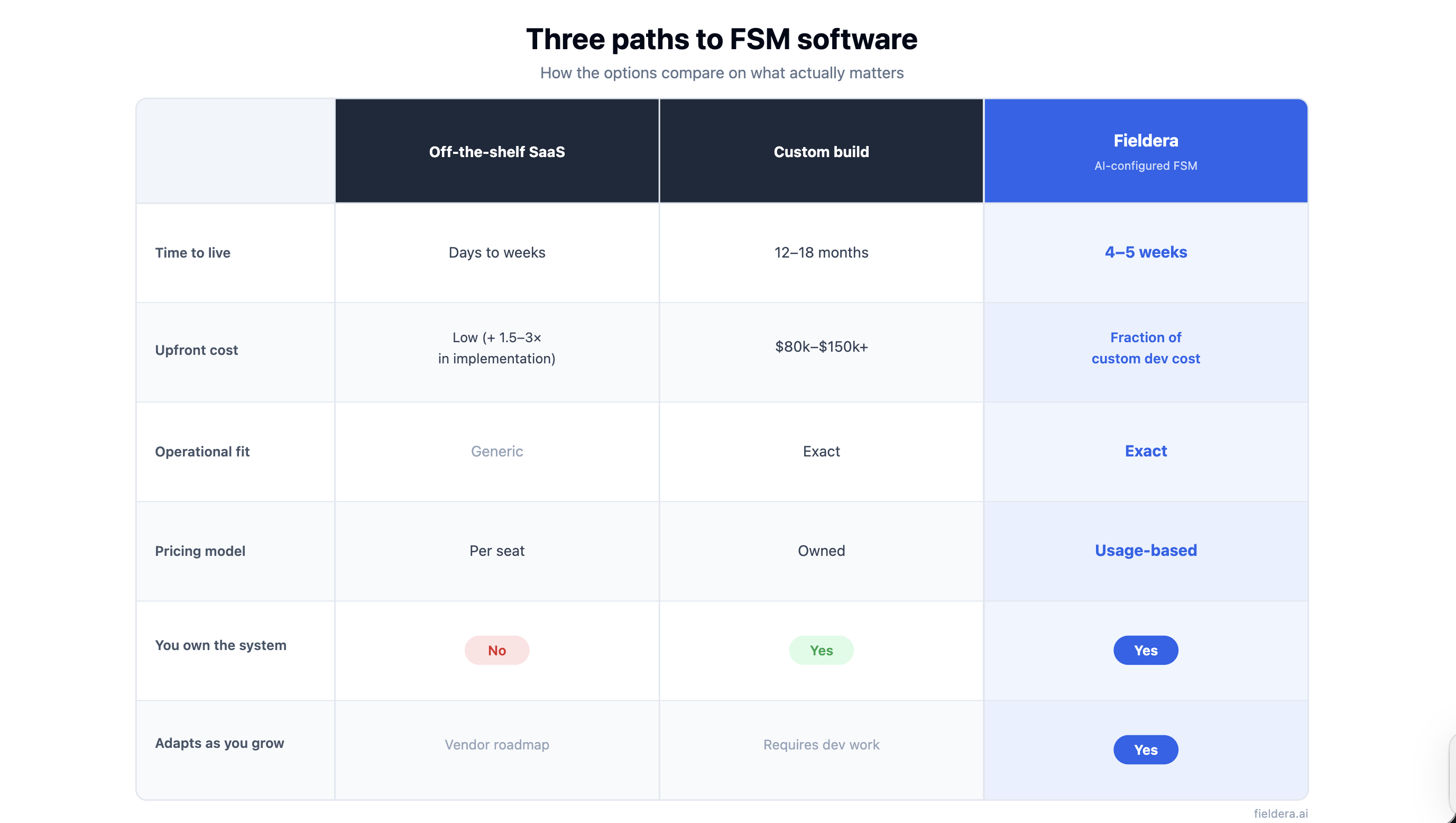
The three paths compared
| Off-the-shelf SaaS | Custom build | AI-configured (Fieldera) | |
|---|---|---|---|
| Time to live | Days to weeks | 12-18 months | 4-5 weeks |
| Upfront cost | Low (+ 1.5-3x in implementation) | $80k-$150k+ | Fraction of custom dev cost |
| Operational fit | Generic | Exact | Exact |
| Pricing model | Per seat | Owned | Usage-based |
| You own the system | No | Yes | Yes |
| Adapts as you grow | Vendor roadmap | Requires dev work | Yes |
How to know which path fits your operation
Most companies that get this wrong evaluate software on features and price before they evaluate it on operational fit.
The right starting question: does your operation match industry defaults, or does it deviate from them in ways that matter to your customers?
Choose off-the-shelf if:
- Your dispatch rules, job types, and compliance requirements are standard for your trade vertical
- You're under 15 technicians and can absorb per-seat costs without them compounding
- You can adapt some internal processes to the tool's defaults
Choose custom if:
- Your specific workflow is genuinely how you compete — the actual mechanism of your value, not just a preference
- You have the budget, timeline, and internal technical capacity to own the system after launch
- Off-the-shelf tools have failed you in ways that configuration can't fix
Choose AI-configured if:
- You've already hit the ceiling of a generic FSM platform, or you can see the ceiling from where you are
- Your operation has site-specific compliance, complex contractor management, or dispatch logic that standard tools can't model
- You want to own the system without commissioning a year-long build
- Per-seat pricing is compounding as your team grows
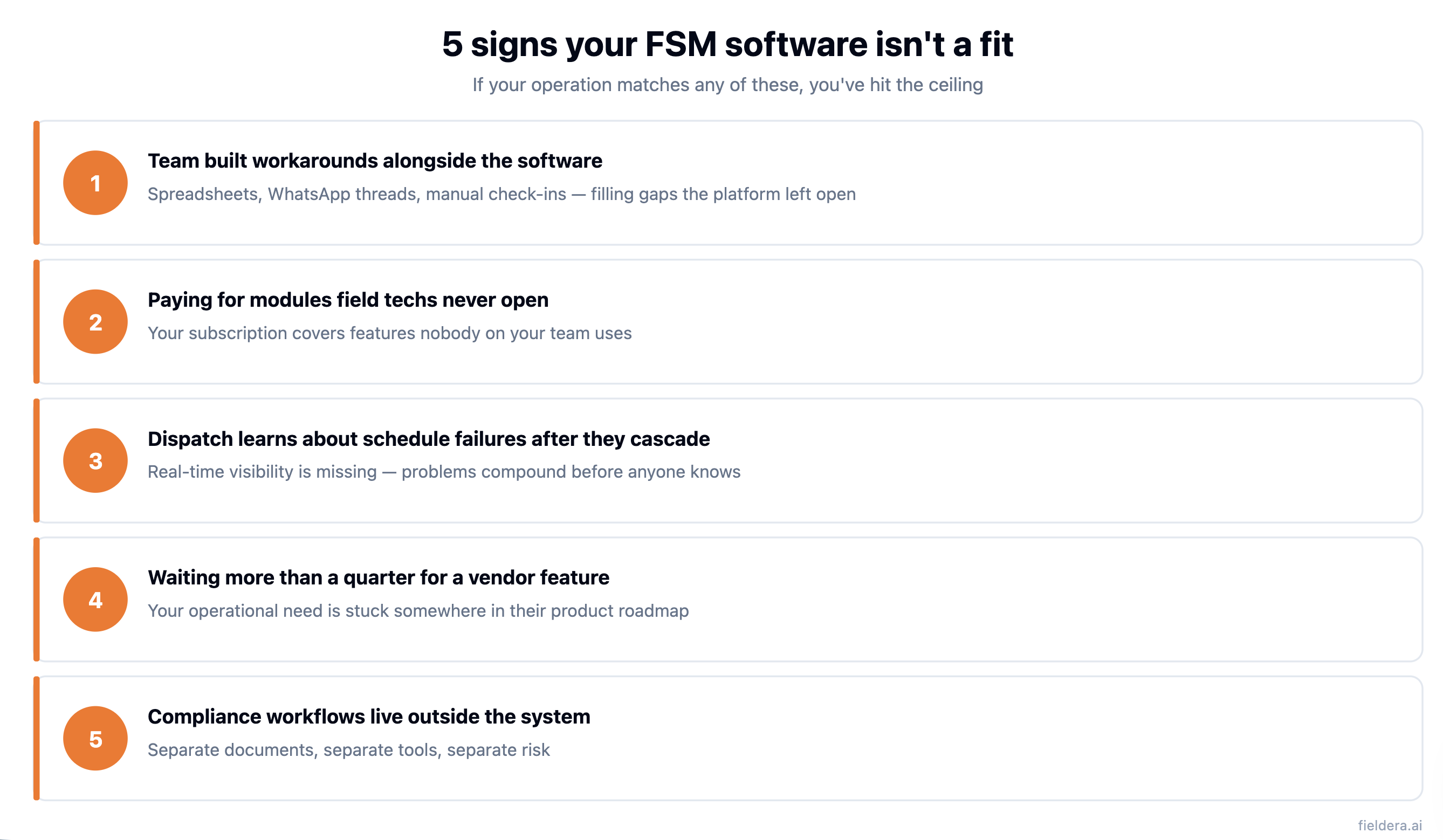
5 signs your current FSM software isn't a fit:
- Your team has built parallel processes alongside the software: spreadsheets, WhatsApp chains, manual check-ins to fill the gaps
- You're paying for modules your field techs never open
- Dispatch finds out about schedule failures after the fact, not in real time
- You've been waiting on a specific feature from your vendor for more than one quarter
- Your compliance workflows or certification checks live outside the system in separate documents
How AI-configured FSM works in practice
Fieldera is built by Brocoders, an engineering company with 10+ years of experience building operational systems for field service companies across installation, logistics, and contractor operations. That domain knowledge is inside the platform before any configuration starts.
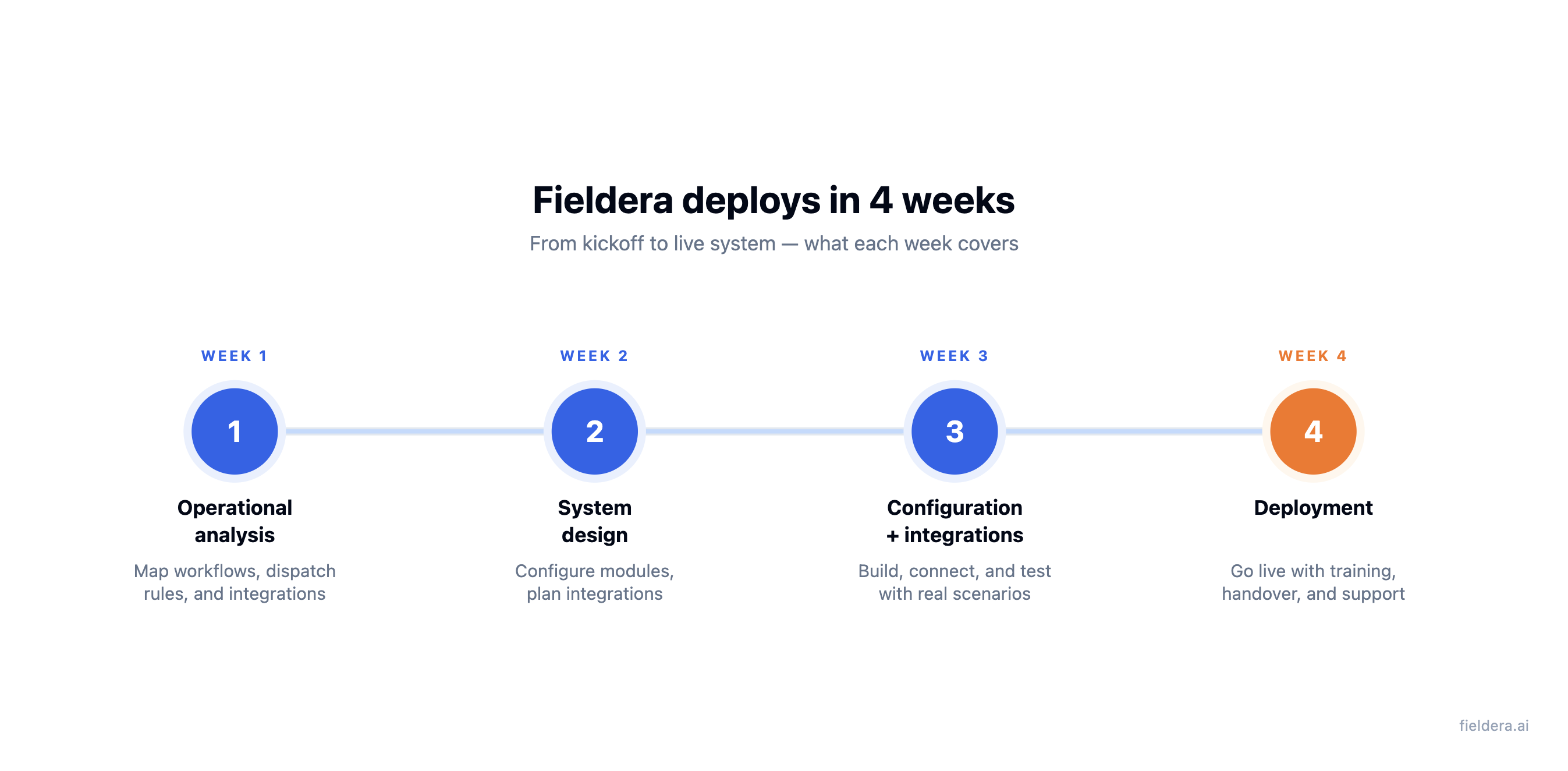
The deployment runs in 4 weeks:
Week 1 — Operational analysis. Map your current workflows: dispatch rules, integration points, compliance requirements, how jobs move from booking to completion. This is the requirements phase that takes 12 months in an enterprise FSM implementation. It takes one week here because the platform already understands field service.
Week 2 — System design. Configure the modules, design the custom workflows, plan ERP and third-party integrations.
Week 3 — Configuration and integrations. Build and connect all systems. Test with real operational scenarios from your business.
Week 4 — Deployment. Go live with training, handover documentation, and ongoing support.
The AI configuration step is what compresses the timeline. Instead of months of back-and-forth between your team and a development agency, orchestrated AI agents translate your operational inputs into working software configurations.
Fieldera is currently working with design partners — companies that want to shape the platform around their specific operation. If your operation has outgrown what you're running now but you're not ready to commission a year-long build, talk to the team at fieldera.ai.
FAQ
What's the difference between buying and building field service management software?
Buying means purchasing a SaaS platform (ServiceTitan, Jobber, Dynamics) and adapting your workflows to it. Building means commissioning custom software development: average cost $132,480, average timeline 13 months. The core trade-off is speed and cost vs. operational fit. AI-configured FSM is a third path that delivers exact operational fit without the 13-month timeline.
How much does custom field service management software cost to build?
Clutch's 2026 verified project data puts the average at $132,480 with a 13-month timeline. Field service apps tend to land above this average due to mobile requirements, offline data sync, GPS tracking, and hardware integrations. Add ongoing maintenance costs post-launch — most field service companies need a continued developer relationship to keep the system current.
What is AI-configured FSM software?
AI-configured FSM starts with a pre-built platform containing standard FSM modules, then uses AI agents to configure it around your specific operational workflows — dispatch rules, compliance requirements, contractor processes, routing logic — rather than asking you to adapt to a generic template. Fieldera deploys these systems in 4-5 weeks. You own the system. Pricing is usage-based, not per seat.
How long does it take to implement field service management software?
Off-the-shelf platforms can be set up in days to weeks, but full implementation including data migration and team training typically takes 1-3 months. Enterprise platforms like IFS take 12-18 months. Custom software builds average 13 months. Fieldera's AI-configured FSM deploys in 4-5 weeks.
What are the signs my FSM software isn't a good fit?
Your team has built workarounds alongside the software: spreadsheets, WhatsApp threads, manual check-ins. You're paying for modules nobody uses. Dispatch learns about schedule failures after they've already cascaded. You've been waiting on a vendor feature for more than a quarter. Your compliance processes live outside the system in separate documents or tools.
Is off-the-shelf FSM software worth it for mid-sized field service companies?
For companies with standard workflows and fewer than 15 technicians, yes. For mid-sized operators with 15-40 techs and non-standard dispatch logic, compliance requirements, or contractor management, the per-seat pricing compounds and the workflow gaps accumulate. The 2025 ACCA study found 56% of contractors with FSM software underutilize it — the platform isn't wrong, the fit is.
Can you customize off-the-shelf field service software to match your workflows?
Most platforms offer configuration options: custom fields, workflow rules, some integration support. For operators with complex dispatch logic, site-specific compliance chains, or multi-tier contractor management, the configuration ceiling is real. When you've hit it, the options are buy a different platform, commission a custom build, or configure with an AI-powered system like Fieldera.
Fieldera is a field operations platform built by Brocoders, configurable to your exact dispatch rules, contractor processes, and compliance requirements — deployed in weeks, not months.
Talk to us about your operation →