A service coordinator at an HVAC company in Columbus told us she was paying $340 a month for FSM software her team used at 30% capacity.
The other 70%? Modules for pool maintenance, lawn care invoicing, and pest control workflows — none of which her team would ever touch. Meanwhile, when an emergency call came in at 2 AM, she still needed four browser tabs open to cross-check technician certifications, parts in each van, and which customers had priority contracts. The FSM didn't cover any of that.
"Off-the-shelf tools assume every job is predictable," she said.
That gap between what generic FSM software promises in a demo and what actually happens in the first 90 days is what this guide is about. Specifically, what to look for in configurable field service management software, and how to tell whether a platform will map to your operation or quietly require your operation to map to it.
How FSM software gets selected (and why it rarely fits)
Most FSM buying decisions start the same way. Someone builds a spreadsheet. Columns for scheduling, dispatch, invoicing, mobile app quality, integrations, price per seat. Five platforms go in. The one with the most checkboxes at the best monthly cost wins.
That process selects for features. Workflow fit doesn't show up in a comparison spreadsheet.
Joshua Mock runs a field refrigeration company. He'd already evaluated ServiceTitan, QuickBooks' own FSM, and FieldPulse before exploring a custom solution. "The problem is they don't do all the features I need," he said. "FieldPulse doesn't sync work orders back to QuickBooks. My credit card reports to QuickBooks and I need work orders to expense so I can job-cost at a work order level rather than just a big customer level."
That's not a niche requirement. That's a standard accounting workflow that any field service company with job-level costing needs. Three platforms, all marketed as complete FSM solutions, didn't handle it natively.
Charlie spent years as VP of Services at IFS, one of the largest FSM platforms on the market. He's seen this play out repeatedly. "I've seen clients select IFS, but where they're at as an organization, it wasn't the right fit for them. Things didn't work out well. It wasn't the software, it wasn't necessarily them, they just didn't realize where they were at."
Feature comparison doesn't surface fit problems. It surfaces capability gaps. A platform can be feature-complete and still wrong for your operation.
The Workflow Friction Tax
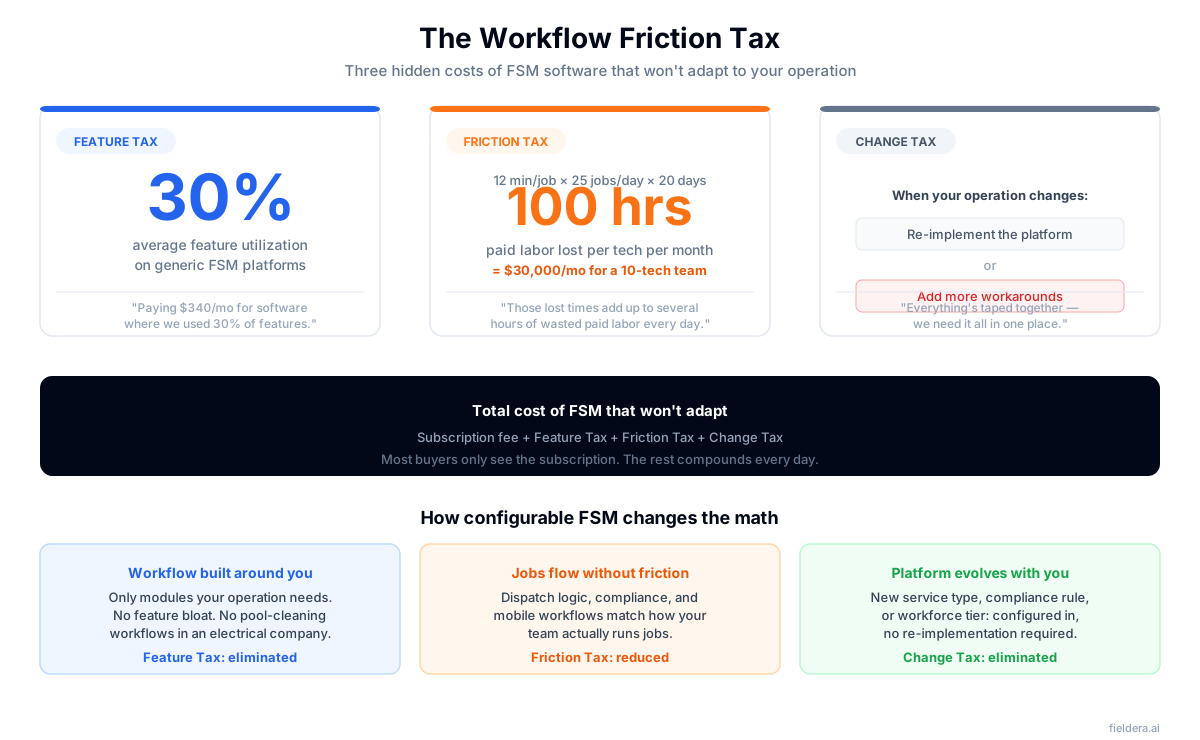
There's a cost most FSM buyers never put in their evaluation spreadsheet. Call it the Workflow Friction Tax.
It compounds across three layers.
The Feature Tax. You pay for everything. You use roughly 30%. Jill Frattini, a service coordinator at Ohio Heating in Columbus, described it directly: "Most platforms are built for generic 'field service' and charge you for pool cleaning workflows, lawn care invoicing, and pest control modules when you just need HVAC-specific stuff like refrigerant tracking and EPA compliance documentation. We were paying $340 a month for software where our team only used maybe 30% of the features."
The Friction Tax. This one multiplies daily. Daniel Vasilevski, owner of Pro Electrical, measured it in real jobs: "If a technician wastes 10 or 15 minutes on every job just trying to input data correctly, the losses are huge. We might complete 25 jobs in a day. Those lost times quickly add up to several hours of wasted labor that is paid, simply because of bad software."
Run the math. 12 minutes of friction per job × 25 jobs × 20 working days = 100 hours of paid labor per technician per month going toward fighting your own software. For a 10-tech operation at $30/hour, that's $30,000 a month. Not subscription cost. Payroll cost.
The Change Tax. Your operation changes. New services, new compliance rules, seasonal workforce shifts. A configurable FSM platform should move with those changes. A generic one either forces a re-implementation or sends your team back to running spreadsheets alongside the FSM, both systems running in parallel, each covering what the other misses.
Matt Davis at SafeRacks (Eagle Industrial Group) described exactly that situation: "Everything's kinda taped together, and so we just need it all in one place."
One Finnish equipment company that had fully migrated to a DMS was still running 20% of its workflows manually outside the system. The platform handled the predictable 80%. The rest lived in WhatsApp groups, email threads, and a shared spreadsheet that someone had to maintain by hand.
Why growing field operations keep switching tools is a pattern worth understanding before you select a platform. The Change Tax is usually what triggers it.
Where configurable FSM outperforms generic platforms
The Friction Tax isn't distributed evenly. Some operations are more exposed than others.
Jobs requiring real-time cross-referencing. When a rooftop unit fails at 2 AM, dispatch doesn't just need an available technician. They need the one certified for that specific VRF system, with the right parts staged in their van, who covers priority-contract customers. Generic FSM platforms weren't built for that decision logic. Jill Frattini at Ohio Heating eventually built a custom dispatch board for $6,000 that could pull live certifications and inventory data. It paid for itself in three weeks by eliminating the wrong-tech-wrong-parts dispatches the generic FSM kept causing.
Compliance-heavy trades. Electrical, refrigeration, and HVAC work involves permits, EPA documentation, worker qualification verification, and job-specific safety protocols. Most generic FSM platforms offer a notes field and a checkbox. That's a workaround, not compliance management. Configurable field service management software can build the compliance workflow directly into the job type: mandatory, tracked, and no longer living in a separate spreadsheet.
Mixed workforces. Operations combining permanent staff, subcontractors, and seasonal workers need different access levels, billing structures, and certification tracking per worker type. Per-seat pricing FSM platforms make this expensive — every contractor added to the system raises your monthly bill. Operations that scale seasonally get punished for growing.
Charlie spoke directly about the HVAC segment: "The challenge they've had with IFS is it feels too complex for them. They're typically pretty agile, allowing things on the fly. They like to be able to change things. They're used to their spreadsheets or some purpose-built system that allows them to do things in a certain way that a larger ERP doesn't allow because it starts locking things down."
When the former IFS VP of Services says a company would probably have been better off building something specific to them, that's a signal worth taking seriously.
Four questions to ask before choosing a configurable FSM
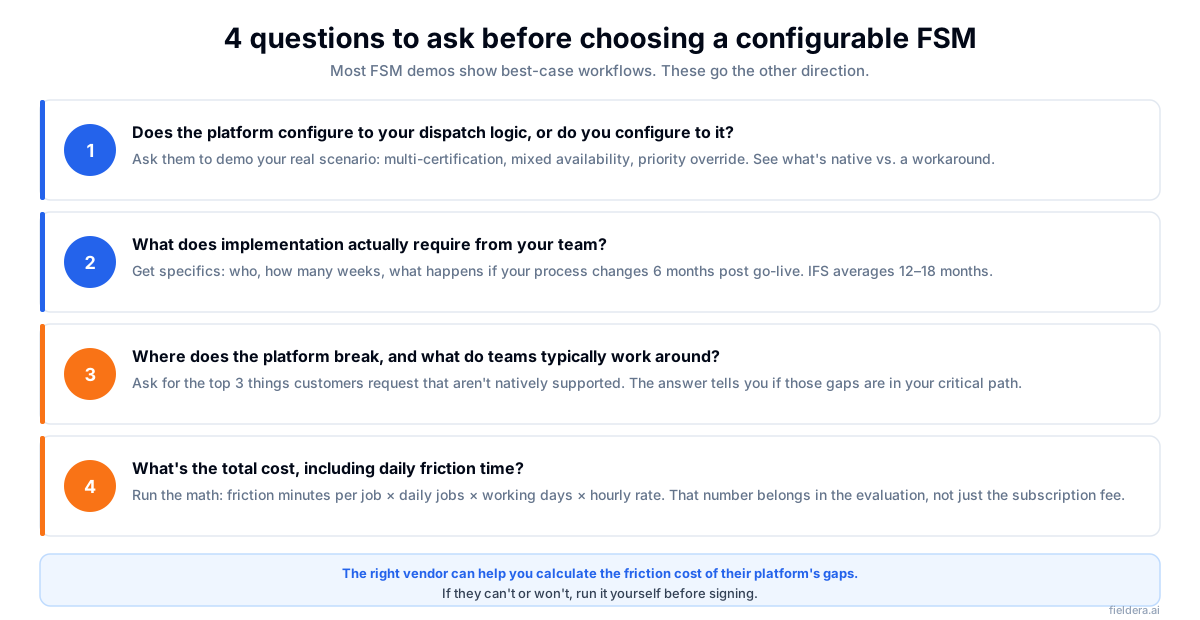
Most FSM demos show you the best-case workflow. These questions go the other direction.
1. Does the platform configure to your dispatch logic, or do you configure your dispatch logic to it?
Ask the vendor to walk through a real scenario from your operation: multi-certification, mixed availability, priority customer override. See whether their platform handles that natively or whether the answer involves a workaround, a custom field, or a note in the job record. The answer tells you where the actual configuration ceiling is.
2. What does implementation actually require from your team?
Get a specific answer: who from your side needs to be involved, how many weeks, and what happens if your process changes six months after go-live. Charlie confirmed that IFS implementations typically run 12 to 18 months. That timeline reflects how much configuration a mid-market operation actually needs. The question is whether that burden fits your situation right now.
3. Where does the platform break, and what do teams typically work around?
No FSM platform is unlimited. A vendor willing to tell you where their product struggles is more trustworthy than one who says they handle everything. Ask for the three things their customers most commonly request that aren't natively supported. The answer tells you whether those gaps are in your critical path.
4. What's the total cost, including daily friction time?
Ask whether the vendor can help you calculate the time cost of their platform's workflow gaps, not just the license fee. If they can't or won't, run the calculation yourself: estimated friction minutes per job × daily job volume × working days × average hourly rate. That number belongs in your evaluation alongside the subscription cost.
What configurable field service management looks like in practice
Configurable FSM sits in its own category, separate from custom development and from a generic platform with extra settings menus.
Custom development builds from scratch. A generic platform gives you settings menus. Configurable field service management software starts with your operation and builds the logic around it.
The distinction is the starting point. Generic FSM platforms are built around a standard field service workflow. Configuration means adjusting settings within that structure: renaming fields, adding job statuses, setting up automation rules. But the underlying logic stays the same for every customer.
Configurable field service management software starts with your operation. Dispatch rules, routing logic, compliance workflows, contractor management, integration with your ERP or CRM: defined by how you actually work, not adapted from a template.
Daniel Vasilevski at Pro Electrical described the outcome clearly: "Putting together a system that is built around our exact processes was the only smart financial decision. It costs more initially but it removes that daily friction. This allowed my team to do more jobs and keep our service up without the daily frustration. The ROI came from that recovered time."
Four markers of a platform that genuinely configures to your operation:
Deployment starts with operational mapping. The vendor should want to understand how your jobs actually run before touching any configuration. If the first call is a product demo, that's a generic platform with good marketing.
Company-specific modules are part of the build. Your compliance workflow, contractor management logic, and dispatch rules should be native to the platform, not add-ons you configure manually after go-live. If it's native, it works. If it's bolted on, it eventually breaks.
Pricing doesn't punish you for growing. Per-seat models mean every new contractor, seasonal worker, or technician raises your monthly bill. Usage-based or flat pricing keeps the math predictable as your field team scales.
The platform can evolve after go-live. When your operation adds a new service type, a compliance requirement, or a new workforce tier, the platform can accommodate it without a re-implementation. You shouldn't be waiting in a feature request queue for changes that are specific to your business.
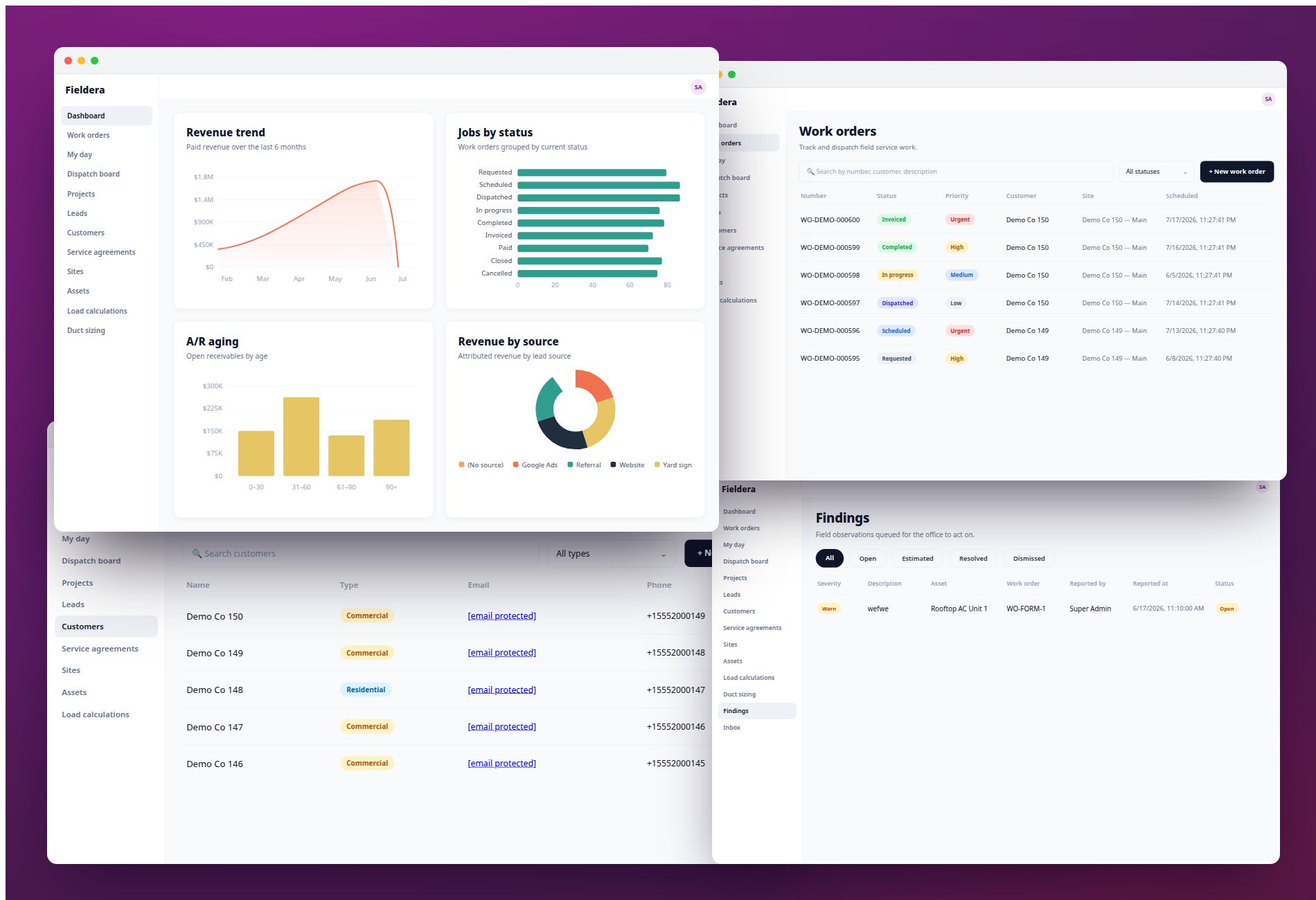
Fieldera is an FSM platform built on this model: AI-configured to specific operational workflows, deployed in 4 to 5 weeks. If your operation has dispatch complexity, compliance requirements, or workflow gaps that generic platforms route around, that's the conversation worth having.
You can also read how these principles apply in specific verticals: HVAC field operations software and managing home installation contractors.
FAQ
What is configurable field service management software?
Configurable field service management software is a platform built to map to your operation's specific workflows, rather than requiring your operation to conform to a predefined structure. This includes custom dispatch logic, company-specific compliance workflows, mixed workforce management, and integration with your existing ERP or CRM systems.
How do I know if my current FSM is a poor workflow fit?
The clearest signal is workarounds. If your dispatch team maintains a separate spreadsheet alongside the FSM, if technicians use WhatsApp to fill communication gaps, or if you've built custom tools to handle specific job types, those are workflow gaps the platform doesn't cover. A second signal: feature utilization. If your team consistently uses less than 40% of what the platform offers, you're funding someone else's software roadmap.
What's the real cost of FSM software that doesn't fit your workflow?
Beyond the subscription, the cost shows up in three places: unused features you pay for (Feature Tax), daily time technicians lose navigating clunky workflows (Friction Tax), and the re-implementation burden when your operation changes and the platform doesn't (Change Tax). For a 10-technician team losing 12 minutes per job across 25 daily jobs, the friction cost alone runs to roughly $30,000 per month in paid unproductive labor.
How long does field service management software implementation take?
It depends on the platform and your operation's complexity. Enterprise FSM platforms like IFS typically run 12 to 18 months. Configurable FSM platforms, designed to map to your operation from the start, can deploy in 4 to 5 weeks when the vendor begins with operational mapping rather than a generic configuration process.
What's the difference between configurable FSM and custom-built software?
Custom-built software is developed from scratch to your exact specification, typically $80–150K upfront with a 6–12 month build timeline. Configurable FSM uses an existing platform foundation with company-specific modules built on top. The result is faster deployment and a lower starting cost, while still fitting your actual workflows instead of a generic template.
Can configurable FSM software integrate with QuickBooks and existing tools?
Yes. QuickBooks integration, ERP sync, and CRM connection are among the main reasons teams switch to configurable FSM. Generic platforms often have partial integrations (one-way syncs, batch exports) that still require manual data entry. A properly configured FSM should handle two-way sync with your accounting and inventory systems natively.
How do I evaluate FSM software beyond the feature list?
Ask the vendor to demo your specific dispatch scenario, not their standard demo flow. Ask where their platform typically breaks and what customers work around. Ask for the full implementation burden on your side, not just the go-live date. And calculate the friction cost of workflow gaps using your own job volume and hourly rates, not the vendor's efficiency benchmarks.
If your operation has dispatch complexity, compliance requirements, or a mixed workforce that generic FSM platforms keep routing around, the Workflow Friction Tax is already running. The feature comparison spreadsheet won't show it. But your technicians and your dispatch team feel it every day.
Configurable field service management software, built around your workflows from the start, is where that cost stops compounding.
Fieldera is a configurable FSM platform built for operational complexity. Deployed in 4–5 weeks. Learn more at fieldera.ai.
Fieldera is a field operations platform built by Brocoders, configurable to your exact dispatch rules, contractor processes, and compliance requirements — deployed in weeks, not months.
Talk to us about your operation →