A rooftop VRF unit fails at 11 PM during a heat wave. The client is a data center. The service contract includes a four-hour response SLA. The dispatcher opens the scheduling platform and looks for the nearest available technician.
The platform shows GPS locations. It shows availability windows. It does not show which technicians hold current VRF certification for that specific manufacturer. It does not show which vans are stocked with the required replacement components. It does not flag that the data center client carries a priority contract requiring a certified commercial tech, not a residential crew.
That information exists somewhere. It lives in a spreadsheet, a group chat, or the dispatcher's memory. The software does not hold it.
This scenario plays out in HVAC operations every season. HVAC companies lose an estimated $120,000 to $250,000 during a major heat wave from scheduling failures alone. Not from a shortage of technicians or parts, but from software that was never built to carry the operational logic that HVAC dispatch actually requires.
Yet the comparison articles published this year evaluate HVAC software the same way they evaluated it five years ago. Feature counts. Star ratings. Pricing tiers. Which platforms work for small teams versus enterprise operations. The comparison tables are thorough and the breakdowns are detailed.
What they do not address is whether any of those platforms were actually built for HVAC, or whether they were built for generic field service and relabeled.
What most HVAC software actually is
The platforms marketed as HVAC software in 2026 fall into two broad categories. The first is general field service management software that added HVAC-specific features over time. ServiceTitan, Housecall Pro, Jobber, and Workiz all began as field service tools for service businesses generally. HVAC features (refrigerant tracking fields, EPA documentation templates, and flat-rate pricing catalogs) were added as the HVAC market grew into a target segment.
The second category is lighter-weight tools built for small HVAC contractors: scheduling, invoicing, QuickBooks sync, and a mobile app. These serve owner-operators and small crews well. The constraints appear when operations grow beyond that original use case.
Both categories handle predictable, scheduled work competently. Maintenance contract renewals, routine tune-ups, and planned replacements fit naturally into standard scheduling tools. Dispatching a technician for a Monday morning furnace inspection does not require real-time certification matching or van-level inventory visibility.
The constraints surface in the work that defines HVAC operations at mid-market scale: emergency calls, complex commercial accounts, multi-certification dispatch, and compliance documentation that must survive an audit. That is the work most HVAC companies generate the majority of their revenue from, and it is the work that generic field service platforms were not designed to support.
Where generic FSM breaks for HVAC specifically
Four failure modes appear consistently across HVAC operations that have grown past the standard use case for their platform.
Emergency dispatch with certification matching
Standard FSM dispatch logic assigns jobs based on technician availability, location, and schedule. That logic works for routine service calls. It does not work for HVAC emergencies, where job requirements are equipment-specific and the stakes for a wrong assignment carry real compliance consequences.
EPA 608 certification is federally required for any technician handling refrigerants. A single dispatching violation can trigger a fine of $44,539 per day per violation. Most HVAC companies employ technicians with different certification types: Type I, Type II, Type III, and Universal. State-level licenses vary by jurisdiction. Each technician typically carries four to twelve active certifications with different renewal cycles.
Generic FSM platforms store this information, if at all, in a notes field or a document attachment. The dispatch board does not cross-reference certification status against job requirements before assigning the job. That matching happens in the dispatcher's head, or it does not happen at all.
Jill Frattini, Service Coordinator at Ohio Heating in Columbus, described the failure mode directly:
"Off-the-shelf tools assume every job is predictable. When a rooftop unit dies at 2 AM in a data center, we need to see which techs are certified for that specific VRF system, what parts are staged in which van, and which client has priority contracts — all while dispatching." — Jill Frattini, Service Coordinator, Ohio Heating
Ohio Heating built a custom dispatch board for $6,000 that pulled real-time technician certifications and van inventory. That board paid for itself in three weeks by eliminating wrong-tech-wrong-parts trips that had been costing $400 or more in wasted labor per call.
Equipment-specific data that generic service fields cannot hold
HVAC service requires equipment-level data beyond what standard FSM record structures store. Refrigerant type and charge amounts, recovery volumes, equipment model and serial numbers, building controller specifications for commercial accounts, and EPA 608 compliance documentation all need to be retrievable at the point of dispatch and verifiable at the point of audit.
Most FSM platforms offer a notes field or a custom field section in the customer record. In practice, this means refrigerant data lives in technician notes, controller specs sit in a shared drive, and audit documentation is assembled after the fact from multiple sources.
Frattini described the consequence in commercial accounts:
"We had techs showing up to thermostat calibrations without knowing if the building used a networked or standalone system because the FSM only had a field for 'yes/no warranty.' That's when custom starts looking cheaper than the workaround labor." — Jill Frattini, Service Coordinator, Ohio Heating
The practical cost is not just wasted trips. It is the audit risk for EPA 608 refrigerant records and the credibility cost when a commercial technician arrives unprepared for the specific system being serviced.
QuickBooks job costing at work-order level
Most HVAC software that claims QuickBooks integration syncs customer records, invoices, and payments. That satisfies basic bookkeeping. It does not satisfy the need that growing HVAC operations have for job-level profitability analysis.
Job costing at work-order level means knowing, per service call, what the labor cost was, what the parts cost was, what the job billed, and what the actual margin was. That analysis requires the FSM and QuickBooks to exchange data at the work-order level, not the customer level.
During a pre-sales evaluation call, Joshua Mock, owner of a refrigeration field service company, walked through this exact problem after evaluating three major platforms:
"The problem is they don't do all the features I need. Field Pulse doesn't sync work orders back to QuickBooks. My credit card reports to QuickBooks and needs work orders to expense so we can job cost at a work order level rather than just a big customer level. Other software creates projects for every work order but fails in other areas." — Joshua Mock, Owner, Refrigeration FSM Evaluation
This is not an edge case requirement. Any HVAC company running job-level profitability analysis needs work-order-level QuickBooks sync. The platforms that claim QuickBooks integration typically mean something narrower than that.
Feature spend for workflows the business will never use
The pricing model for most field service platforms includes features built for the full range of industries the platform serves. Pool cleaning workflows, lawn care invoicing structures, pest control documentation modules, and general home services scheduling logic are included in the subscription regardless of whether the HVAC company uses them.
Frattini put the business impact plainly:
"Most platforms are built for generic 'field service' and charge for pool cleaning workflows, lawn care invoicing, and pest control modules when the business needs HVAC-specific capabilities like refrigerant tracking and EPA compliance documentation. When humidity levels and combustion analysis matter more than generic 'service notes,' the business is funding someone else's wishlist." — Jill Frattini, Service Coordinator, Ohio Heating
Ohio Heating was paying $340 per month for a platform where the team used roughly 30% of the available features. The remaining 70% funded a roadmap built around other industries' needs.
The HVAC Complexity Threshold
The HVAC Complexity Threshold is the point at which an HVAC company's operational requirements generate more friction from its current software than value from it. Below the threshold, established platforms (Jobber, Housecall Pro, Workiz, and FieldCamp) handle the work adequately. Above it, the question shifts from "which HVAC software fits best" to "does this platform configure to how this operation dispatches, or does the operation configure itself to how the platform was built?"
Four markers indicate that an HVAC company has crossed the Threshold.
Marker 1: Emergency dispatch requires real-time certification-to-job matching. Availability and location are not sufficient to assign emergency calls correctly. The dispatch decision depends on knowing which technician holds the specific certification required by that job and that equipment type.
Marker 2: Serviced equipment generates compliance-critical data. Refrigerant charge amounts, recovery volumes, controller specifications, and EPA 608 documentation need to be stored and retrievable at the work-order level, not in a notes field or a separate spreadsheet.
Marker 3: Job profitability needs to be tracked at work-order level. Knowing what each service call costs against what it billed requires QuickBooks sync at the work-order level, not the customer or invoice level.
Marker 4: Wrong-tech-wrong-parts trips are a recurring cost. When technicians are dispatched without real-time cross-referencing of certifications, van inventory, and job requirements, the wrong-tech-wrong-parts problem becomes predictable and regular. At $400 or more per incident in wasted labor, it becomes a measurable operational cost.
An HVAC company that has crossed two or more of these markers is not facing a software selection problem. It is facing a platform fit problem. The answer is not a better comparison list. It is a platform that holds the operational logic the dispatcher currently carries in their head.
What HVAC operations look like when the software fits
The contrast between a workflow-fit platform and a generic FSM tool becomes visible in how emergency dispatch actually runs.
A dispatch board configured to HVAC's operational requirements shows, in a single view: which technicians are available, which certifications each holds, which SLA tier applies to each client, and which vans carry the components required for the job type. The dispatcher does not cross-reference a spreadsheet. The system holds that logic and enforces it at job assignment.
Equipment records hold refrigerant types and recovery amounts, controller model numbers and network configurations, service history with readings, and compliance documentation attached to the work order that generated it. When an auditor requests EPA 608 records, the documentation is in the FSM, not assembled from five different sources.
Work orders sync to QuickBooks at job level. Profitability is visible per call, not per customer. Operations managers can identify which service types generate margin and which erode it, by technician, by account, and by season.
New technicians added to the field do not add a per-seat line to the software invoice. Usage-based pricing means a growing contractor workforce does not carry a software tax.
When an HVAC company's software is configured to its actual dispatch requirements rather than to a generic field service model, the dispatcher stops being the bridge between the system's limitations and the operation's needs. That time goes back into managing the schedule instead of compensating for the software.
How HVAC companies choose software in 2026
The right starting point is the Threshold framework, not a feature checklist.
For HVAC companies that have not crossed the Threshold (smaller operations with predictable scheduling, limited commercial accounts, and no multi-certification dispatch complexity), standard platforms cover the functional requirements well. Housecall Pro and Jobber serve smaller teams effectively. Workiz and FieldCamp have positioned well in the one-to-fifty technician segment with AI-powered dispatching at accessible pricing.
For companies in the mid-market gap (typically ten to thirty technicians, too complex for lightweight tools and too cost-conscious for ServiceTitan's $63,000-plus year-one investment), the relevant question is platform fit, not platform features.
Five questions to ask in any HVAC software evaluation:
1. Can the dispatch board surface technician certifications and van inventory in real time, or does that matching happen outside the system?
A system that holds that logic is a dispatch tool. A system that requires manual cross-referencing is a calendar.
2. What does the equipment record hold for commercial accounts with networked controllers?
If the answer is a notes field, that data is as current as the last technician who remembered to update it.
3. Does QuickBooks sync operate at work-order level or customer level?
This answer determines whether job-cost analysis is possible, not just bookkeeping.
4. Is pricing per-seat or usage-based?
The answer determines the economics of adding technicians as the operation grows.
5. What does the deployment process look like, in weeks?
An implementation timeline longer than six to eight weeks for a standard FSM deployment signals product complexity, not operational complexity.
John Williams, Chief Executive Officer of Stan's Heating, Air, Plumbing & Electrical, with 31 years in the industry, uses ServiceTitan specifically for its dispatch analytics and technician performance tracking. That depth is appropriate for a large, established operation with the implementation budget and onboarding resources to match. For companies in the mid-market range, the same analytical depth is available in platforms that configure to the operation without the implementation overhead.
Where Fieldera fits
Fieldera is a field operations platform built by Brocoders, a software company with 10-plus years building operational and workflow systems across installation, logistics, and contractor-based field operations in the US and Europe.
The structural difference from established HVAC platforms is how configuration works. Fieldera uses AI to configure the platform to a client's exact dispatch logic, technician certification requirements, equipment record structure, and compliance documentation workflow. The software adapts to the operation rather than requiring the operation to adapt to the software's available options.
Standard modules ship with every deployment: work orders and job management, scheduling and dispatch, technician mobile app, contractor management, job reporting and documentation, time and materials tracking, and invoicing. Company-specific modules include certification-based dispatch rules, refrigerant compliance tracking, QuickBooks sync at work-order level, and site-specific commercial equipment records, configured to the specific operation's requirements in four to five weeks.
Brocoders' FSM experience includes SafeRacks and Eagle Industrial Group (installation operations across 50-plus contractors and eight US states), CFI Furniture and TradeFlex (two-sided contractor marketplace with field operations), Backbone International (event production field ops), and Revenue Boosters (vending route management). These builds are the source of the FSM patterns that Fieldera is deployed from.
Pricing is usage-based. Adding technicians does not add per-seat cost. The platform is hosted and maintained by Brocoders and reconfigures as the operation's requirements change.
HVAC operations that have crossed the Complexity Threshold, or are approaching it, can reach the team at fieldera.ai.
Conclusion
The answer to "what is the best HVAC software" depends on where the operation sits relative to its Complexity Threshold.
Below it, established platforms handle the work well. Housecall Pro and Jobber for smaller residential-focused operations. Workiz and FieldCamp for teams that need AI-powered dispatching without enterprise pricing. ServiceTitan for large operations with the budget and resources to match its implementation requirements. These are competent tools serving the audience they were designed for.
Above the Threshold, the category question changes. The right platform is not the one with the most HVAC-labeled features. It is the platform that holds the certification logic, equipment data, compliance documentation, and job-cost sync that an HVAC dispatcher currently carries in their head, in a spreadsheet, or in a separate system kept current by hand. In 2026, with HVAC operations facing rising compliance complexity and a mid-market segment that standard platforms serve poorly on both ends, the distinction between those two answers is worth getting right.
FAQ
What is the best HVAC software in 2026?
The best HVAC software depends on the operational complexity of the company. For smaller residential operations, Housecall Pro, Jobber, and Workiz are well-regarded options with strong mobile apps and accessible pricing. For larger commercial operations with the budget to match, ServiceTitan provides the deepest feature set. For mid-market HVAC companies (typically ten to thirty technicians) with complex dispatch requirements, multi-certification tracking, or commercial equipment compliance needs, the relevant question shifts from which standard tool fits best to which platform can be configured to the specific operation.
What HVAC software works best with QuickBooks?
Most HVAC platforms integrate with QuickBooks at the customer and invoice level. Work-order-level job costing (tracking costs and margins per service call rather than per customer) requires a deeper QuickBooks sync that most standard platforms do not provide. HVAC companies that run job-profitability analysis per call should verify whether any platform under evaluation syncs at work-order level before selecting it.
What features should HVAC management software include?
Core features include scheduling and dispatch, technician mobile app, work order management, invoicing, and customer records. For HVAC operations specifically, the features that matter most at mid-market scale are: real-time certification matching at dispatch, equipment records that hold compliance-critical data (refrigerant types, EPA documentation, and controller specs), QuickBooks sync at work-order level, and usage-based pricing that does not scale against headcount. The presence of these features (not the total feature count) determines whether the software fits an HVAC operation or a generic field service model.
How much does HVAC business software cost?
HVAC software pricing ranges from free (entry-level tools) to more than $63,000 in year-one costs for enterprise platforms like ServiceTitan. Mid-market platforms typically cost between $1,000 and $15,000 per year on per-seat models. Usage-based pricing models do not increase cost per technician added, which changes the long-term economics significantly for growing contractor workforces.
Is ServiceTitan worth it for a small HVAC company?
ServiceTitan is built for large HVAC operations with the resources to support a complex implementation. Year-one costs typically exceed $63,000, and full onboarding takes two to twelve months. For smaller HVAC companies, the investment and implementation complexity are generally disproportionate to the operational requirements. Housecall Pro, Jobber, and Workiz offer more accessible pricing and faster setup for operations that do not need ServiceTitan's full feature depth.
Can HVAC software track EPA certifications and refrigerant compliance?
Most HVAC platforms include some refrigerant tracking functionality. The gap is in how that data connects to dispatch. A platform that stores EPA 608 certification records but does not cross-reference them at the point of job assignment creates audit documentation but does not prevent compliance violations. Dispatching a technician to a refrigerant-handling job without verifying current EPA 608 certification carries a potential fine of $44,539 per day per violation. The relevant question for any platform evaluation is whether certification status actively prevents non-compliant dispatch, or whether it exists only as a record-keeping field.
What is the difference between HVAC software and field service management software?
HVAC software is a marketing category. Most platforms sold under that label are general field service management tools with HVAC-specific features added. Field service management (FSM) software is the broader category covering any industry with dispatched field crews. The meaningful distinction is not the label but the depth of configuration. HVAC-labeled platforms are optimized for the common residential service case. FSM platforms that configure to specific operational requirements (dispatch certification logic, commercial equipment data structures, and compliance tracking embedded in the job workflow) handle the complexity that HVAC operations develop as they grow past straightforward residential scheduling.
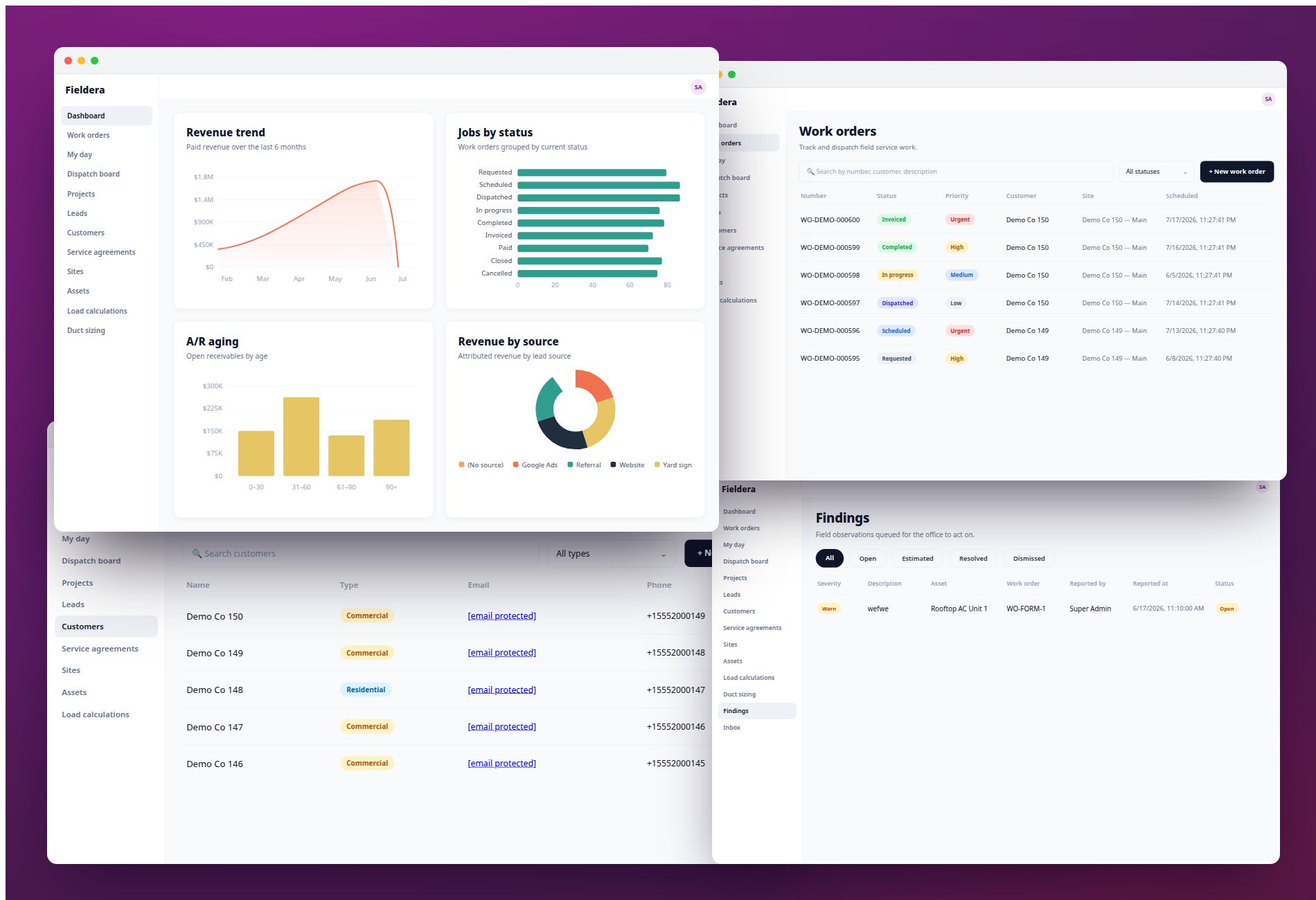
Fieldera is a field operations platform built by Brocoders, configurable to your exact dispatch rules, contractor processes, and compliance requirements — deployed in weeks, not months.
Talk to us about your operation →